
yeida mixed use land regulations near jewar airport
Discover the exciting developments around the Noida International Airport at Jewar and the importance of mixed-use plots along the Yamuna Expressway. Understand YEIDA regulations to make informed decisions for your investments and yeida mixed use land regulations near jewar airport
NCR REGION UP
Rajesh Kumar
4/20/20268 min read
My dear friends, have you ever stood in the middle of a dusty field, squinting against the sun, and tried to imagine a world-class city rising out of the dirt? Because that’s exactly what I did last month when I took a drive out toward the Yamuna Expressway. I’m telling you, the energy out there is something else. You can practically hear the future humming.
With the Noida International Airport at Jewar finally taking shape, everyone and their cousin is talking about land. But not just any land—people are obsessed with these "mixed-use" plots. Let's explore this now, because as far as reality is concerned, if you don't understand the rules the Yamuna Expressway Industrial Development Authority (YEIDA) has put in place, you’re basically flying blind.
In my experience, the term "mixed-use" sounds a bit like a salad bar. You get a little bit of everything. But in the world of YEIDA regulations, it’s a very specific recipe. Without further ado, let’s proceed into what makes these regulations tick and why they matter for your new website, your business, or even just your curiosity.
The Real Deal on YEIDA Mixed Use Land Regulations
I have observed that most people get confused the moment they hear the word "regulations." They think of dusty law books and boring meetings. But really, these rules are just a roadmap for how this new city will look.
YEIDA decided that they didn’t want a boring city where you work in one place and live twenty miles away. They wanted a vibe where things are blended. So, they created the Mixed-Land-Use (MLU) category. Essentially, if you snag one of these plots, you aren't stuck just building a warehouse or just an apartment complex. You get to mix it up.
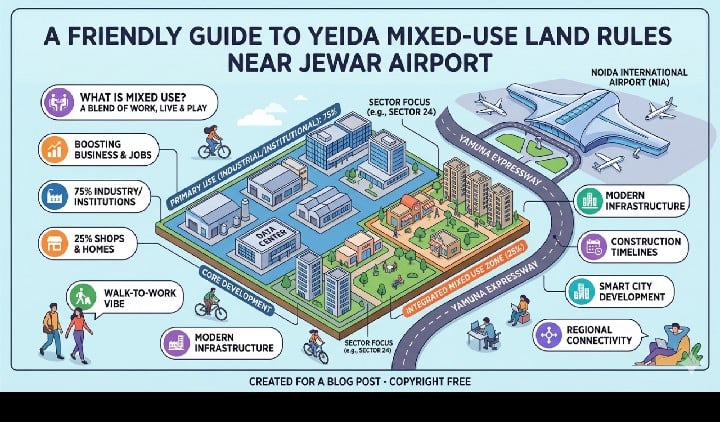
The big rule you need to know is the 75-25 split. I feel that this is the most important part of the whole deal. Usually, for these massive plots—we’re talking 40,000 square meters and up—YEIDA wants you to use 75% of the land for your primary purpose. This is usually something industrial or institutional, like a big data center or a high-tech factory.
But here’s the kicker: the remaining 25% is where the magic happens. You can use that space for commercial or residential stuff. Think about it. You could have a factory where 75% of the land is making car parts, and on the other 25%, you’ve got apartments for the workers and a small strip mall with a coffee shop and a pharmacy. It’s like building a mini-city on one piece of dirt.
Why Sector 24 is the Main Event Near Jewar Airport
I was chatting with a buddy of mine, Raj, who’s been eyeing property near the airport for three years. He told me, "I missed the boat on Sector 18, but I’m not letting Sector 24 go." And he’s right to be excited.
As far as reality is concerned, Sector 24 is currently the superstar of mixed-use land. It’s sitting right there along the Yamuna Expressway, super close to the Eastern Peripheral Expressway and the upcoming Film City. If the airport is the heart of the region, Sector 24 is like the main artery.
In my experience, location isn't just about being "near" something; it's about how easy it is to get there. YEIDA has been very strict about the road widths and green belts in this sector. You aren't going to find narrow, cramped streets here. We’re talking wide avenues that can handle big trucks for the industrial side and plenty of room for people to walk on the residential side.
I’ve seen the plans, and the authority is pushing for "world-class facilities." Now, I know that sounds like fancy talk, but it basically means they want parks, good drainage, and power that doesn't go out every time the wind blows. If you’re looking at these regulations, keep an eye on the specific sector maps. Not all mixed-use land is created equal, and Sector 24 is definitely the favorite child right now.
Making Sense of the Money and the Ratios
Let's talk about the price because, let's be honest, that’s what everyone really wants to know. I’ve noticed that people often gasp when they see the price tags on these plots. We’re talking about prices ranging from roughly ₹16,600 to over ₹17,600 per square meter. When you multiply that by a 40,000-square-meter plot, you’re looking at a serious chunk of change—sometimes over ₹60 crore!
But don't let the big numbers scare you off. The regulations for payment are actually pretty fair. Usually, you have to pay about 10% as a registration fee just to get into the game. If you're lucky enough to get an allotment, you pay another 20% within 60 days. The rest? You can pay that over five years in ten half-yearly installments.
I feel that this payment plan is one of the better things YEIDA has done. It gives businesses time to start building and generating some cash before they have to hand over every single penny.
Also, keep an eye on the "location charges." In my experience, if your plot is on a corner or faces a big park, they’re going to tack on an extra 5% to 15% to the price. It’s like getting the "ocean view" at a hotel. It costs more, but it usually pays off when you try to sell it later.
The Rules for Building and Construction
So, you’ve got your land. Now what? Well, YEIDA has some very specific thoughts on how you build. You can’t just throw up a shack and call it a day.
First off, there’s the Floor Area Ratio, or FAR. This is just a fancy way of saying how much total floor space you can build compared to the size of your plot. For mixed-use plots, the FAR is usually around 1.5 to 2.0. If you’re building something that helps the public—like a hospital or a school—they might even give you a bit more.
I have observed that many people forget about the construction deadlines. My dear friends, please don't be one of those people! YEIDA usually gives you about three years to finish your building. If you don't, they start charging you "extension fees."
Right now, as of April 2026, there’s a bit of a silver lining. Because some of the infrastructure like roads and electricity took longer than expected, the authority actually gave people a one-year extension. Instead of finishing by the end of 2025, many have until December 31, 2026, to get their occupancy certificates. It’s a huge relief for folks who were struggling with labor or materials.
How the Allotment Process Actually Works
If you think you can just walk into the YEIDA office with a suitcase of cash and buy a plot, I have some news for you. It doesn't work like that.
For these big mixed-use plots, it’s not a "draw of lots" like the smaller residential plots. It’s more like a job interview. They look at your company's profile, how much money you have in the bank, and what kind of projects you’ve done before.
I feel that this is actually a good thing. It keeps out the "flippers" who just want to buy land and sit on it until the price goes up. YEIDA wants people who are actually going to build something that creates jobs.
When you apply, you have to submit a detailed project report. They’ll score you on a points system. If you have a solid track record and a plan that fits the "vision" of the airport region, you’ve got a real shot. I’ve seen small startups get rejected because their paperwork was messy, while well-prepared companies cruised through the process. It’s all about doing your homework.
Life Near the Airport: The Human Side of the Regulations
Let’s step away from the numbers for a second. What is it actually going to be like to live or work on this mixed-use land?
I went out for a snack at a small dhaba near the expressway last week, and I talked to a local farmer who had sold some of his land to the authority. He told me, "Ten years ago, this was just a place where we grew wheat. Now, my son is training to work in aviation logistics."
That’s the "why" behind these mixed-use regulations. It’s not just about land; it’s about people. By allowing residential and commercial spaces right next to factories and offices, YEIDA is trying to make sure that the people who work at the airport or in the nearby industries have a decent life.
Imagine finishing your shift and walking five minutes to your apartment, then grabbing dinner at a local restaurant on the same block. No two-hour commutes in soul-crushing traffic. That’s the dream they’re selling, and as far as reality is concerned, it’s a pretty good one.
In my experience, these "walk-to-work" cultures are the only way to build a city that doesn't drive everyone crazy. The regulations ensure that there are enough green spaces and public areas so the whole place doesn't turn into a concrete jungle.
Common Mistakes to Avoid When Dealing with YEIDA
I’ve seen a lot of people make some pretty painful mistakes when they try to navigate these rules. Let’s explore this now so you can avoid them.
The biggest mistake? Buying "village land" or "unauthorized land" that claims to be near the airport but isn't part of the YEIDA master plan. My dear friends, I cannot stress this enough: if it isn't YEIDA-approved, you are taking a massive risk.
I know a guy who bought a cheap plot from a local dealer. He thought he got a steal. Two years later, the authority came through to build a road, and because his plot wasn't registered properly, he didn't get any compensation. It was heartbreaking.
Another mistake is ignoring the "one plot per family" rule for residential components. If you try to get sneaky and apply for multiple plots under different family members' names, they will catch you. They use Aadhaar and PAN cards to track everything now. If they find out you’re double-dipping, they’ll cancel your allotment and keep your deposit. It’s just not worth the risk.
Finally, don't forget the maintenance charges. Once you have your plot, you have to pay for things like security, street lighting, and sewage. These aren't huge costs, but they add up, and if you don't pay them, it can cause headaches when you try to get your building permits.
Looking Ahead to 2026 and Beyond
As we move through 2026, the excitement is only going to grow. The airport is getting closer to its full opening, and the demand for mixed-use land is going through the roof.
I have observed that the authority is getting even more modern with their rules. They’re now talking about "Data Center Parks" and "Smart Logistics Hubs" that fit into these mixed-use categories. They want the region to be a hub for technology, not just old-school manufacturing.
If you’re thinking about getting involved, now is the time to start your research. Read the brochures, visit the sectors, and maybe even talk to a legal expert who knows the ins and outs of the Yamuna Authority.
In my experience, the people who win in real estate are the ones who have patience. This isn't a "get rich quick" scheme. It’s a "wait ten years and see your investment quadruple" kind of deal. The regulations are there to protect the long-term value of the land, so while they might feel like a hassle now, they’re actually your best friend in the long run.
I feel that we are witnessing the birth of one of the most important cities in India. It’s messy, it’s dusty, and it’s full of paperwork—but it’s also incredibly exciting.
So, my dear friends, whether you’re planning to build a factory, open a shop, or just invest your savings, keep these mixed-use regulations at the front of your mind. They are the rules of the game, and if you play the game right, the rewards can be life-changing.
Let's keep an eye on how things develop over the next few months. I’ll be out there on the expressway, checking out the progress and probably getting some more dust on my shoes. I wouldn't have it any other way!