
yeida building bye laws for residential plots near airport
Discover essential insights on the 2026 YEIDA building bye-laws for the Yamuna Expressway region. Ensure your plot is secure and navigate the complexities of building your dream home near the booming Noida International Airport.yeida building bye laws for residential plots near airport
NCR REGION UP
Rajesh Kumar
4/12/20267 min read
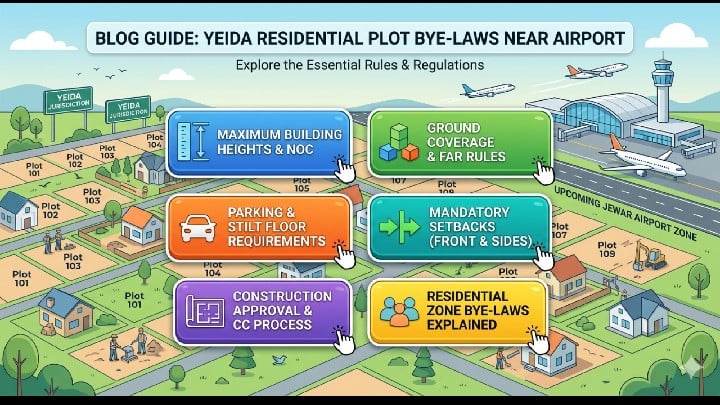
Hey there, my dear friends! If you’ve been keeping an eye on the news lately, you know that the buzz around the Noida International Airport in Jewar has reached a fever pitch. It feels like only yesterday we were talking about this airport as a "maybe" or a "someday" project. Now, here we are in April 2026, and the whole landscape has changed. I’ve observed so many people—from young families to seasoned investors—trying to snag a piece of land in the Yamuna Expressway area.
But here’s the thing: buying the land is only half the battle. If you want to actually build your dream home, you have to play by the rules. The Yamuna Expressway Industrial Development Authority (YEIDA) has some pretty specific "building bye-laws" that you need to follow. Since these plots are so close to a major international airport, the rules are a bit different than what you might find in the middle of a city. Without further ado, let’s proceed into the nitty-gritty of what you can and cannot build on those residential plots.
The Basics of YEIDA Ground Coverage and FAR
In my experience, the first thing everyone asks is, "How much of my plot can I actually cover with concrete?" My dear friends, this is what the authority calls "ground coverage." You can't just build from one edge of your property to the other. You need to leave some breathing room.
For most of the standard residential plots we see in Sectors 18 and 20—the ones that are around 300 square meters—the ground coverage usually hovers around 65%. I feel that’s actually quite generous. It means you still have a decent amount of space for a small garden or a courtyard. If you’ve managed to grab one of those massive 4,000 square meter "villa" plots, the rules change. For those big guys, the ground coverage drops down to about 35% or 40%. The authority wants those larger estates to feel open and green, not like a crowded apartment block.
Then there’s the FAR, or Floor Area Ratio. Think of this as the total amount of floor space you’re allowed to have across all your levels. Usually, for a standard residential plot, the FAR is around 1.8 to 2.0. Let’s explore this now with a simple example. If you have a 200 square meter plot and your FAR is 2.0, you can build a total of 400 square meters of floor area. You can spread that out over two or three floors. I’ve seen some people get confused and think they can just keep building up as long as they stay within the footprint, but the FAR is the hard limit on your total "indoor" space.
Keeping it Low Near the Runways: Height Restrictions
Now, this is where things get interesting because of the airport. As far as reality is concerned, you can't just build a skyscraper next to a runway. Safety is the name of the game here. Within a 20-kilometer radius of the Noida International Airport, the height rules are very strict.
I have observed that any building or even a tall tree that goes above 15 meters—which is roughly 49 or 50 feet—needs a special "No Objection Certificate" (NOC) from the Airports Authority of India (AAI). If your house stays under 15 meters, you’re usually in the clear and can skip a lot of the extra paperwork. For most people building a three-story home with a stilt floor, 15 meters is plenty of height. However, if you have grand visions of a tall tower with a viewing deck to watch the planes take off, you’re going to have to deal with the AAI’s online portal, NOCAS.
YEIDA is very serious about this. They recently updated their bye-laws to align perfectly with the AAI’s "Colour-Coded Zoning Map." Depending on exactly where your plot sits in relation to the flight path, your height limit might even be lower than 15 meters. Always check the specific map for your sector before you fall in love with a high-ceiling design.
Parking and Basements: Where to Put the Car
Parking is a massive headache in most Indian cities, but YEIDA is trying to get ahead of the problem. In many of the newer schemes, like the 2026 plot scheme in Sectors 15-C and 24, they are really pushing for "stilt parking."
Basically, a stilt floor is an open ground floor used primarily for parking your cars. In my experience, this is a lifesaver. It keeps the streets clear and keeps your car out of the blazing sun. Here’s the best part: the stilt floor usually doesn’t count toward your FAR. That means you get "free" square footage for your cars without sacrificing the size of your living room on the upper floors. However, the height of the stilt floor does count toward your total building height. So, if your stilt is 2.5 meters tall, that leaves you with 12.5 meters for the rest of your house if you want to stay under that 15-meter "no NOC" limit.
What about basements? I love a good basement for a home theater or a gym, but YEIDA has rules for those too. You can generally build a basement that matches the footprint of your ground floor. But be careful—you can’t use it as a bedroom or a separate apartment. It’s strictly for storage, parking, or "service" activities. I feel that as long as you use it for a cool hangout spot or a laundry room, the authority won't give you any grief. Just don't try to rent it out as a "studio apartment" because that’s a big no-no.
Setbacks: Don't Forget Your Neighbors
Setbacks are those mandatory empty spaces between your house and the boundary wall. You might call them your front yard, back yard, or side alleys. YEIDA requires these to ensure everyone has access to light and air.
If you’re on a smaller plot, you might only need a setback in the front and the back. But for plots over 300 square meters, you usually have to leave space on at least one side as well. For the really big plots—those over 1,000 square meters—you have to leave a "setback" of 6 meters or more all the way around.
Let me tell you a quick story. A buddy of mine, let's call him Amit, bought a plot in Sector 18. He wanted to build right up to the edge to maximize his kitchen size. When he submitted his plans, the authority rejected them instantly. He had to move his entire layout back by three meters. It cost him time and architect fees. So, take it from Amit: respect the setbacks! These gaps are what make the Yamuna Expressway sectors feel so much more organized and "high-end" compared to the older, cramped neighborhoods in other parts of the region.
The Process of Getting Your Map Approved
You can't just hire a contractor and start digging the day after you get your allotment letter. You need a "Sanctioned Map." This is where you hire an architect who is registered with YEIDA. They will take your dreams and turn them into a set of technical drawings that follow every single bye-law we’ve talked about.
Nowadays, the process is mostly online. You submit your drawings, pay the "stacking charges" and "malba" (debris) fees, and wait for the approval. In my experience, if your architect knows what they’re doing and follows the rules, you can get your map approved in a few weeks.
Once you finish building, there’s one final hurdle: the Completion Certificate (CC). This is the authority’s way of saying, "Okay, you actually built what you said you were going to build." They will send an inspector to check your setbacks, your height, and your FAR. If you’ve cheated and added an extra room on the roof, they won’t give you the CC. And without that certificate, you can't get a permanent electricity or water connection. It’s a bit of a hassle, but it’s the only way to keep the neighborhood looking good.
What Makes These Sectors Special Near the Airport
I have observed that the vibe in these airport-adjacent sectors is going to be very different from Noida or Greater Noida. Because of the height restrictions, we won’t see massive 40-story apartment towers looming over every single plot. Instead, we’re going to see a lot of "low-rise" luxury.
I feel that this creates a much more "human-scale" environment. You’ll be able to see the sky. The parks won’t be in permanent shadow. Plus, the infrastructure they’re laying down right now is world-class. We’re talking about wide roads, underground wiring (no messy hanging cables!), and plenty of green belts.
When you combine these strict building laws with the proximity to the airport, the film city, and the upcoming industrial hubs, you’re looking at a very high standard of living. My dear friends, if you follow the rules and build a home that respects the bye-laws, you aren't just building a house; you’re building an asset that will likely be worth a fortune in the next ten years.
Final Thoughts for Future Homebuilders
As we wrap this up, I want to remind you that these rules change occasionally. While I’ve given you the lowdown as of 2026, always have your architect double-check the latest "Master Plan 2041" documents on the YEIDA website before you pour any concrete.
Building a home is an emotional journey. It’s where you’ll raise your kids or retire. It’s tempting to try and "bend" the rules to get an extra few feet of space, but in the long run, it’s just not worth the stress. Stick to the ground coverage limits, keep an eye on your height so you don't need that AAI NOC, and make sure you leave those setbacks for your garden.
I’m so excited to see how these sectors look in another couple of years. Every time I drive down the Yamuna Expressway, I see more and more houses going up. It’s a sign of progress, and I’m glad you’re thinking about being a part of it. Good luck with your construction, and may your new home near the airport be everything you’ve ever dreamed of!