
yeida authority plot transfer charges and process
Discover the essential guide to buying or selling a Yeida plot near the new Jewar Airport. Learn about transfer charges, the step-by-step process, and the necessary documents to simplify your property transaction.yeida authority plot transfer charges and process
NCR REGION UP
Rajesh Kumar
4/2/20266 min read
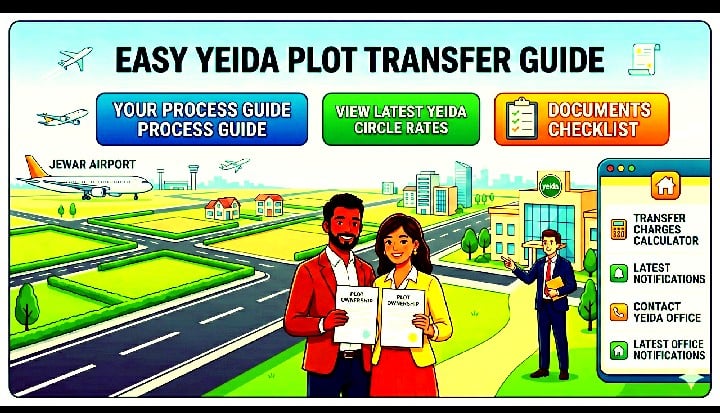
My dear friends, have you seen the news lately about the Yamuna Expressway? It feels like every time I turn on the TV or scroll through my phone, there is something new happening near the Jewar Airport. With the airport finally opening its doors this year in 2026, the whole area is buzzing like a beehive. I have observed so many of you asking about how to actually get your hands on a plot there, or more importantly, how to transfer one if you are buying from the secondary market.
It can feel a bit like trying to solve a giant puzzle, right? One person tells you one thing, and the official website tells you another. Believe me, I get it. In my experience, navigating the world of government authorities like YEIDA (Yamuna Expressway Industrial Development Authority) requires a bit of patience and a good map. Since so many of you are looking to build your dream home or make a smart investment near the new "aviation hub," I thought we should sit down and chat about how the plot transfer process actually works and what it’s going to cost you.
Let's explore this now, without any of that confusing legal talk that makes your head spin.
What are YEIDA Transfer Charges?
As far as reality is concerned, buying a plot directly from the authority in a lucky draw is great, but let’s be honest—most of us end up buying from someone else who already won a plot years ago. When you buy a "resale" plot, you aren't just handing over a suitcase of cash and getting a key. You have to officially tell YEIDA that the ownership is changing.
This is where the Transfer Memorandum (TM) comes in. Think of it as the authority’s "blessing" for the sale. And, of course, they want a small slice of the pie for doing the paperwork.
In the past, these charges were quite high—sometimes as much as 5% or even 10% of the plot's value. But I have some good news for you! My dear friends, the authority has become a bit more buyer-friendly lately. Currently, for residential plots, the transfer charge usually sits at around 2.5% of the current circle rate.
Now, don't let that "circle rate" part trip you up. The circle rate is just the minimum price the government sets for land in a specific area. Since it’s 2026 and the airport is operational, the circle rates in Sectors 18, 20, and 22D have definitely climbed. I feel that it is very important to check the latest rates for your specific sector before you start counting your pennies. For example, if the circle rate is ₹35,000 per square meter, you’ll be looking at a transfer fee of about ₹875 per square meter. It adds up, but it is much better than the old rates!
The Step-by-Step Transfer Process
Without further ado, let's proceed to the actual "how-to." I remember a friend of mine, let's call him Rahul, who tried to do this all by himself last year. He ran back and forth to the Greater Noida office five times because he kept missing one little paper. I don't want that to happen to you!
Here is the path you need to follow:
1. Clear the Deck (Get Your NDC)
Before you can even think about transferring, the seller must prove they don't owe the authority any money. This means paying off all installments, interest, and lease rent. You need to get a No Dues Certificate (NDC). I have observed that many deals fall through at the last minute because the seller forgot about a tiny "water tax" or a late fee from three years ago. Double-check everything!
2. Apply for the Transfer Permission
Once the dues are clear, the seller and buyer together apply for "Transfer Permission." You do this through the YEIDA online portal. You’ll need to upload the original allotment letter and a few other basics. After you submit this, the authority takes a look to make sure the plot isn't in any legal trouble or tied up in a court case.
3. Pay the Fees
After the authority gives the green light, it is time to pay the TM charges we talked about earlier. You’ll usually get a "challan" or a payment link. Once you pay that 2.5% (plus any small administrative fees, which are usually a few thousand rupees), you are halfway home.
4. Execute the Transfer Deed
This is the big moment. You head to the Sub-Registrar’s office (usually in Greater Noida or Jewar) to sign the Transfer Deed. This is the official legal document that says the land belongs to you now. You’ll have to pay Stamp Duty here, which is generally 7% in Uttar Pradesh, though women buyers sometimes get a 1% discount.
5. Mutation (The Final Step)
I feel that this is the step people forget most often. Just because you have the registry papers doesn't mean YEIDA’s records are updated. You must apply for Mutation in the authority's books. Once that is done, your name will finally show up as the official owner on the YEIDA website.
Essential Documents You Cannot Forget
If you are going to the authority office or even just uploading files online, you need your ducks in a row. In my experience, having a physical folder with three copies of everything is the only way to stay sane.
Here is your checklist:
Original Allotment Letter: The seller must have this.
Possession Letter: If the authority has already handed over the plot.
No Dues Certificate (NDC): Proving the slate is clean.
ID Proofs: Aadhar Card and PAN Card for both the buyer and the seller.
Photographs: Carry at least four passport-sized photos each.
Witnesses: You’ll need two people with their IDs to sign the papers at the registrar's office.
I once knew a lady who forgot her PAN card and had to drive three hours back home to get it. Don't be that person! Keep it all in one bright folder so you can't miss it.
The Five-Year Lock-in Rule
Now, I have to give you a little "heads-up" about something very important. As far as reality is concerned, YEIDA doesn't want people just flipping plots like pancakes to make a quick buck. They want people to actually build houses and live there.
Because of this, many of the newer schemes—like the ones launched in late 2024 or 2025—have a lock-in period. Often, you cannot transfer a plot for five years from the date of allotment.
However, there is a loophole (of sorts). You can sometimes do what’s called a "Transfer of Memorandum" before five years if you pay a much higher fee, or if there are specific family circumstances. But generally, if you are buying a brand-new allotment, be prepared to hold onto it for a few years. If you are buying an older plot from the 2009 or 2013 schemes, you can usually transfer those without this headache.
Why Is Everyone Moving to Yamuna City?
You might be wondering, "Is all this paperwork really worth it?"
Well, my dear friends, let me tell you a short story. Five years ago, the area around the Yamuna Expressway was just empty fields. People used to joke that the only thing you could find there was dust and blue cows (Nilgai).
But look at it today in 2026! The Noida International Airport is a world-class facility. The Film City project is bringing in the glitz and glamour of Bollywood. There is a dedicated Medical Device Park and a Toy Park creating thousands of jobs.
When you buy a plot here, you aren't just buying a piece of dirt. You are buying a front-row seat to the future of North India. I have observed that the people who bought plots back when they were "cheap" are now sitting on a gold mine. Even with the transfer charges and the registry fees, the potential for the land to grow in value is still huge.
Final Tips for a Smooth Transfer
Before I let you go, I want to share a few "pro tips" from my experience. These will save you money and a lot of gray hair.
First, always check for hidden dues. Sometimes a seller might say "all clear," but there could be an "additional compensation" demand from the farmers that hasn't been paid yet. YEIDA often asks for extra money to pay the farmers whose land was taken. Make sure you know who is paying that—the buyer or the seller.
Second, use a professional if you feel overwhelmed. There are plenty of consultants who specialize in YEIDA work. They charge a fee, but they know the clerks, they know the process, and they can spot a fake document from a mile away.
Third, visit the plot in person. It sounds simple, right? But you would be surprised how many people buy land just looking at a map. Go there. See where the nearest park is. Check if the roads are actually built.
I feel that if you follow these steps and stay patient, you will be very happy with your investment. The Yamuna Expressway is a beautiful stretch of road, and having your own little piece of it is a great feeling.
If you have any questions about specific sectors or if you are confused about a certain fee, just let me know. We are all in this together, and I want to see you succeed!
Happy house hunting, or should I say, plot hunting!