
YEIDA Approved Plots vs Freehold Land in Jewar
Explore the essential differences between YEIDA approved plots and freehold land in Jewar. With the Noida International Airport on the horizon, make informed investment choices that can secure your future in this burgeoning area.YEIDA Approved Plots vs Freehold Land in Jewar
NCR REGION UP
YEIDA Approved Plots vs Freehold Land in Jewar
4/4/20267 min read
My dear friends, if you have been watching the news lately or just chatting with anyone who has a pulse on the real estate market, you know that Jewar is the place to be. With the Noida International Airport finally being inaugurated just a few days ago on March 28th, things are moving fast. Everyone is looking for a piece of the pie before the first commercial flights take off later this month. But here is the thing: when you start looking at land in this area, you are going to run into two very different types of deals. On one hand, you have YEIDA approved plots, and on the other, you have freehold plots.
I have observed that many people get these two confused, and that can lead to some pretty big headaches down the road. It is easy to see a cheap price tag and want to jump on it, but as far as reality is concerned, you need to know exactly what you are signing up for. Let’s explore this now so you don’t end up making a mistake that costs you your hard-earned savings.
The real scoop on the Jewar airport buzz
Before we dive into the nitty-gritty of the plots, we have to talk about why this is happening. As of April 2026, the vibe in Jewar is electric. I was just talking to a buddy of mine who drove past the airport site last week, and he said the transformation is mind-blowing. The planes are basically ready to roll, and the whole region is transforming from sleepy farmland into a massive global hub.
Because of this, land prices have been climbing like crazy. If you bought land here five years ago, you are probably sitting on a goldmine right now. But for those of us looking to buy today, the stakes are higher. You aren't just buying dirt; you are buying a spot next to what will eventually be one of the biggest airports in the world. This is why choosing between an authority-backed plot and a private freehold plot is the most important decision you will make.
Getting to know YEIDA approved plots
When people talk about the "safe" way to invest in Jewar, they are usually talking about YEIDA. For those who aren't familiar with the lingo, YEIDA stands for the Yamuna Expressway Industrial Development Authority. These folks are the bosses of the land development in this specific zone.
When you buy a YEIDA approved plot, you are basically buying land that the government has already cleared, planned, and mapped out. In my experience, this is the gold standard. In fact, the authority just announced a new residential scheme earlier this year, RPS-10, offering plots in sectors like 15C and 24A. These are prime spots.
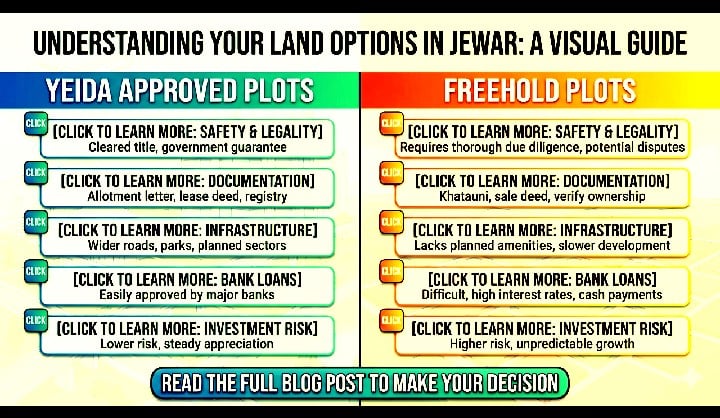
Without further ado, let’s proceed into why these are so popular. First, the title is clear. You don't have to worry about some long-lost cousin showing up three years later claiming he actually owns the left half of your backyard. The government has already done the legwork. Second, the planning is top-notch. They decide where the roads go, where the parks are, and where the schools will be built. You aren't just buying a plot; you are buying into a community that actually has a blueprint.
The lowdown on freehold plots in Jewar
Now, let’s talk about the "other" option. Freehold plots are a bit of a different beast. Usually, these are plots that belong to local villagers or private individuals. They aren't part of the official YEIDA sectors. Instead, they might be located in or around the existing villages near the airport.
I feel that freehold plots get a bad rap sometimes, but they do have their perks—mostly the price. If you look at the 2026 market rates, a YEIDA plot might cost you a pretty penny (around ₹35,000 per square meter in the new schemes, and way more in the resale market). A freehold plot, however, will usually be much cheaper.
But there is a catch. These plots often lack the fancy infrastructure. You might be buying a beautiful piece of land, but who is going to build the sewage system? Where is the electricity coming from? In many cases, these plots are basically agricultural land that someone decided to carve up and sell. As far as reality is concerned, you are taking a much bigger gamble here. I have seen folks buy freehold land thinking they could build a villa, only to find out later that the land wasn't even cleared for residential use.
Breaking down the big differences in safety
Safety is the big one. I always tell my friends that if you can't sleep at night because you’re worried about your investment, then it wasn't a good investment.
With YEIDA plots, the "safety" comes from the fact that everything is documented by the state. You get an allotment letter, a lease deed, and a registry that is backed by the government. If there is a dispute, you have a massive organization behind you. It’s very official.
Freehold plots are "free" in the sense that once you buy them, you own them forever (unlike YEIDA which is technically a 90-year lease). But that "forever" only matters if the paperwork is solid. I have observed that in the villages around Jewar, land records can sometimes be a bit... messy. You really have to do your homework. You need a lawyer to check the "Khatauni" (land records) and make sure there aren't any hidden liens or family disputes. If you miss one detail, your investment could vanish.
Let’s talk about the money and bank loans
If you need a loan to buy your plot—and let's be honest, most of us do—this is where the path splits.
Banks love YEIDA. If you walk into a major bank with a YEIDA allotment letter, they will practically roll out the red carpet for you. They know the land is legit, they know the value is going to go up, and they know the paperwork is clean. You can get a home loan or a land loan with decent interest rates without much of a struggle.
Freehold plots? That’s a whole different story. Most big-name banks won't even touch a freehold plot in a rural area unless it has very specific approvals. You might have to go to a smaller, private finance company, and they are going to charge you an arm and a leg in interest. Or worse, you might have to pay the whole thing in cash. In my experience, trying to get a loan for a "Lal Dora" or village plot is like trying to find a needle in a haystack. It’s tough, and it’s frustrating.
Infrastructure and the lifestyle you get
Let's imagine for a second that you’ve bought your plot and you’re ready to build.
If you’re in a YEIDA sector, you’re going to have wide roads. We are talking 12-meter to 18-meter wide roads that can actually fit two cars passing each other. You’ll have dedicated power lines, water connections, and green belts. It feels like a modern city. The authority is currently working on connecting these sectors directly to the airport and the Bullet Train station. It’s all very "future-forward."
Now, let's look at a typical freehold plot near a village. You might be relying on a narrow dirt path to get to your house. Your water might come from a borewell you have to dig yourself, and the electricity might be a bit "hit or miss" depending on the local grid. I’m not saying it’s impossible to live there—plenty of people do—but it’s a much more "rugged" lifestyle. If you’re looking to build a high-end rental property for airport staff, they are probably going to want the amenities that come with a YEIDA plot.
The hidden risks you need to know about
I want to be real with you guys. There is a risk with freehold land that many people don't talk about until it's too late: land acquisition.
Since the government is building a massive airport and an entire "Aviation Hub," they need a lot of land. Sometimes, they decide they need a specific patch of land for a new road or a warehouse. If your freehold plot happens to be in the way, the government can acquire it. While they do pay compensation, it might not be as much as you hoped, and the process can be a legal nightmare.
YEIDA plots are already "acquired" and "developed." The government isn't going to take back land they already sold to you for residential use. That gives you a layer of protection that freehold owners just don't have.
Making the right call for your investment
So, which one should you pick? Well, I feel that it really depends on your budget and your "risk appetite," as the fancy folks say.
If you are a first-time investor and you want to be able to sleep at night, go with YEIDA. Yes, it’s more expensive. Yes, you might have to wait for a lucky draw to get one at a good price. But it is a "set it and forget it" kind of investment. You know it’s safe, you know it’s legal, and you know the value will climb as the airport starts buzzing with tourists this summer.
However, if you are a seasoned pro who knows how to navigate local land records, and you’re looking for a "high risk, high reward" play, maybe you look at freehold. You can get more land for less money. Just promise me you’ll hire a really good lawyer to check those papers!
At the end of the day, Jewar is changing the face of the entire region. Whether you go the official route or the private route, you are stepping into an area that is about to become the center of the map. Just keep your eyes open, do your research, and don't let the excitement cloud your judgment.
I hope this helps clear things up for you. Investing in land is a big deal, and I want to see you all come out on top. If you have any more questions about the different sectors or how the new airport opening is affecting things, just let me know.