
rera rules for buying agricultural land near jewar airport
Discover the ground reality of buying agricultural land near the upcoming Jewar Airport. Learn about UP RERA rules, the section 143 land conversion process, and YEIDA regulations to safeguard your investment. rera rules for buying agricultural land near jewar airport
NCR REGION UP
Rajesh Kumar
3/12/20266 min read
The Ultimate Guide to RERA Rules for Buying Agricultural Land Near Jewar Airport
Welcome to the Ground Reality of Jewar Real Estate
My dear friends, if there is one topic that completely dominates the conversations at every tea stall, family gathering, and investor meetup across Uttar Pradesh and the Delhi-NCR region today, it is the phenomenal rise of the Noida International Airport at Jewar. Being based right here in Anupshahr, in the Bulandshahr district, I have had a front-row seat to this incredible transformation. Just a few short years ago, the long stretches along the Yamuna Expressway were quiet, undisturbed expanses of farmland. Today, they represent one of the most dynamic, rapidly appreciating real estate corridors in the entire country.
With the massive infrastructure push, everyone wants a piece of the pie. Buyers from Delhi, Noida, and beyond are flocking to the region, eager to secure land before prices skyrocket out of reach completely. However, with this great opportunity comes immense confusion. The rush to acquire property has led to a chaotic market, particularly when it comes to buying agricultural land and understanding exactly how UP RERA (Uttar Pradesh Real Estate Regulatory Authority) rules apply to these transactions.
The Allure of the Airport and Master Plan 2041
As far as reality is concerned, the hype surrounding the Jewar region is entirely justified by concrete government plans and massive developmental strides. The upcoming Agra Master Plan 2041 is projected to create a massive urban and industrial center near the airport. Authorities are preparing for an economic boom that could potentially generate up to 10 lakh jobs in sectors ranging from information technology and logistics to tourism and manufacturing. The proposed urban centers will not just be concrete jungles; the master plan includes provisions for solar energy parks for clean power, advanced waste and sewage treatment plants, biodiversity parks, and pollution-controlled industrial zones. It is a vision of a modern, sustainable city.
Because of this projected growth, circle rates in the region are undergoing significant revisions. In fact, recent proposals have suggested increasing the circle rates for agricultural land in the Jewar area by up to 70%. This kind of anticipated appreciation makes buying raw land incredibly tempting.
In my experience, many buyers come to the Bulandshahr and Jewar regions looking for a serene escape—perhaps dreaming of setting up a peaceful farmhouse, a quiet yoga retreat, or a small naturopathy center amidst the green fields. While the vision of cultivating a healthy, holistic lifestyle away from city pollution is beautiful, the legal foundation of that dream must be rock solid. Unfortunately, many enthusiastic investors are purchasing raw agricultural land or unauthorized farmhouse plots from local brokers, assuming they can simply lay a foundation and build a structure whenever they please. They hear the acronym "RERA" tossed around as a blanket guarantee for property safety, without fully understanding what the law actually covers.
Does RERA Apply to Agricultural Land?
Let's explore this now, because this is the exact intersection where the most costly financial mistakes are made. Does UP RERA apply to the purchase of agricultural land? The short, definitive answer is: No.
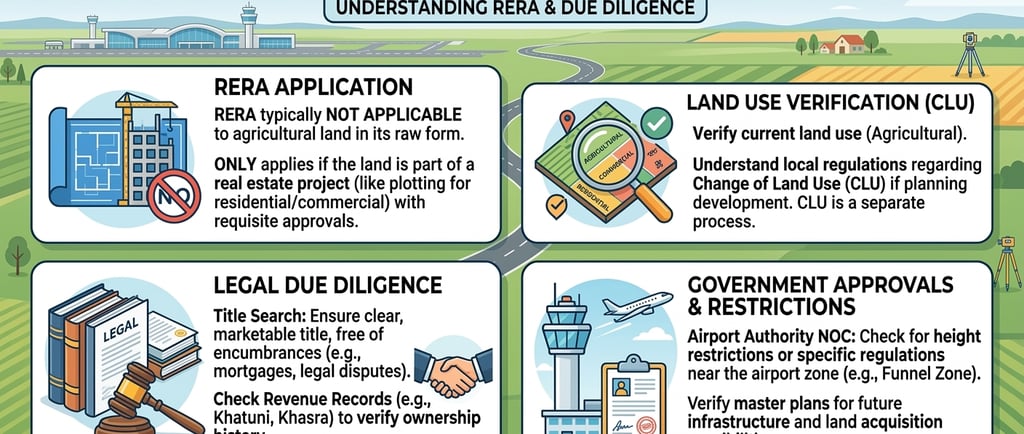
The Real Estate (Regulation and Development) Act of 2016 was specifically designed to protect homebuyers and ensure transparency in real estate projects. Pure agricultural land—land that is sold and bought exclusively for the purpose of farming or cultivation—is completely exempt from RERA registration. If you are buying a raw piece of farmland directly from a farmer, that transaction falls completely outside the jurisdiction of the Real Estate Regulatory Authority.
The dangerous trap is set when unscrupulous developers or brokers buy a large parcel of agricultural land, divide it into smaller, bite-sized plots, and market them to city dwellers as a "premium farmhouse scheme" or an "upcoming residential colony." They will often promise future amenities like paved internal roads, electricity connections, streetlights, and water supply, all without ever converting the land use or obtaining the necessary layout approvals from the local authorities.
Under the law, if a developer is creating a plotted development and offering shared amenities, and the project exceeds 500 square meters in total land area or involves more than eight plots, it must be registered with UP RERA. If someone is selling you a small, unapproved plot cut out of agricultural land without a valid UP RERA registration number, you are making a highly risky, legally vulnerable investment. If the project stalls, or if the government decides to crack down on illegal plotting, RERA will not be able to help you because the project was never legally recognized or registered in the first place.
The Section 143 Conversion Requirement
Without taking up any more time, let's proceed to the actual legal mechanism you must use if you want to build on farmland. You cannot simply buy a patch of green field near the Yamuna Expressway and start laying bricks for a house or a commercial establishment.
If you purchase agricultural land in Uttar Pradesh with the intention of using it for anything other than farming, you must obtain a formal declaration under Section 143 of the UP Zamindari Abolition and Land Reforms Act (which is transitioning under the framework of the UP Revenue Code). This process officially converts the land use from agricultural to non-agricultural (residential, commercial, or industrial).
Until the Sub-Divisional Magistrate (SDM) officially recognizes and signs off on this Section 143 conversion, any non-farming construction on that land is technically illegal. Without this conversion, you cannot legally construct a building, you will not be able to secure a home loan from a bank against the property, and you risk facing severe penalties, including demolition orders from the state government. Applying for this conversion is a meticulous process that requires submitting a mountain of paperwork, including your sale deed, the mutation certificate (Dakhil Kharij), an official land survey map, and the latest land tax receipts. Furthermore, conversion is never guaranteed—especially if the land in question is highly fertile or falls within a designated green belt.
The 10-Kilometer Radius Ban and YEIDA Regulations
Another massive factor that buyers completely overlook is the stringent zoning laws enforced around the new aviation hub. Currently, there is a strict prohibition on unauthorized construction on abadi (village habitation) land or agricultural land within a 10-kilometer radius of the Noida International Airport.
The Yamuna Expressway Industrial Development Authority (YEIDA) holds the reins when it comes to planned development in this zone. If you are planning to build a home or invest in land near the airport, the plot ideally needs to fall under a notified YEIDA sector, such as Sectors 15C, 18, 20, 22D, or 24A. YEIDA frequently releases residential plot schemes—like their highly anticipated 2026 scheme, which includes hundreds of plots reserved for the general public—offering regulated properties with clear, undisputed titles. These plots are allotted through a highly transparent, computerized draw of lots, which is exactly why seasoned investors prefer them over risky private developments on village borders.
Even if you manage to secure a legal, converted plot in the vicinity, you cannot simply start building a multi-story structure. Before commencing construction, you are required to apply through the Airports Authority of India (AAI) online portal for a No Objection Certificate (NOC) regarding height clearance. This ensures your building complies with strict aviation safety guidelines and height norms. Following that, your actual building map and layout must be explicitly approved by YEIDA or the relevant local development authority.
Your Essential Due Diligence Checklist
To protect your hard-earned money and ensure your investment near the Jewar Airport is safe, you must follow a strict checklist before signing any sale deed or transferring funds:
Verify the Title: Always start by checking the UP Bhulekh website. Ensure the person selling you the land is the actual, legally recorded owner and that the dimensions match what is being promised on the ground.
Obtain an Encumbrance Certificate (EC): This crucial document, obtained from the Sub-Registrar's office, guarantees that the property is free from any hidden legal debts, pending mortgages, or ongoing ownership disputes. You should ideally ask for an EC covering the last 12 to 15 years.
Check the Mutation (Dakhil Kharij): Mutation simply means the property's ownership has been legally altered in the government revenue records. Ensure the plot is properly registered in the seller's name in the revenue department's books.
Confirm Land Use: Check whether the land is classified for residential use. If it is still marked as agricultural, remember that the burden of Section 143 conversion will fall entirely on your shoulders.
Demand the RERA Number: If you are buying a plot within a larger private layout or township, demand the UP RERA registration number from the developer. Do not take their word for it. Go to the official UP RERA website (up-rera.in), enter the project registration number, and verify the project details, the approved layout plans, and the quarterly construction progress.
Physical Inspection and Survey: Never buy land purely based on glossy brochures or WhatsApp forwarded videos. Always visit the physical location yourself. Walk the perimeter, assess the approach roads, and hire a licensed private surveyor to physically measure the land and cross-check it against the official documents provided by the seller.
Final Thoughts
The real estate market around the Noida International Airport offers a once-in-a-generation opportunity for wealth creation and the development of beautiful, purpose-driven properties. However, navigating the intersection of agricultural land laws, YEIDA master plans, and UP RERA regulations requires immense patience and thorough due diligence.
Do not let the fear of missing out push you into a hasty decision. Avoid village land deals that promise "immediate registries" without proper development approvals, and be highly skeptical of heavy discounts for early bookings in unapproved farmhouse projects. Play by the rules, ensure your paperwork is immaculate, and your investment in the Jewar region will stand strong for generations to come.