
RERA Approval Mandatory for Freehold Plots in UP?
Discover the truth about RERA approval for freehold plots in Uttar Pradesh. Don't be misled by labels; understand the legal reality of 2026 and the 500 sqm rule. Get informed now!RERA Approval Mandatory for Freehold Plots in UP?
NCR REGION UP
Rajesh Kumar
3/18/20265 min read
RERA Approval Mandatory for Freehold Plots in UP? Your 2026 Guide
My dear friends, buying a piece of land is perhaps one of the most emotional and significant financial decisions we ever make. In our country, and specifically in a state as vast and dynamic as Uttar Pradesh, owning "Dharti" (land) isn't just about an investment; it’s about legacy, security, and a sense of belonging. However, the real estate market can often feel like a maze, filled with technical jargon that leaves even the most seasoned investors scratching their heads. One question that I hear constantly—whether I’m at a social gathering in Lucknow or chatting with colleagues in Noida—is: "Is RERA approval mandatory for freehold plots in UP?"
There is a common misconception that if a plot is "freehold," it somehow exists in a legal vacuum where the rules of the Real Estate Regulatory Authority (RERA) don't apply. People often think that "freehold" means "free from all regulations." Let’s explore this now, and peel back the layers of these regulations to see what the law actually says in 2026.
Understanding the Basics: Freehold vs. RERA
Before we dive into the "mandatory" part, we need to be on the same page about these two terms. A freehold plot is one where the owner has complete ownership of the land and the building on it forever. Unlike leasehold property (common in Noida or Greater Noida), there is no "landlord" like a development authority to whom you pay ground rent or from whom you need permission to transfer the title.
RERA, on the other hand, is the watchdog. Established under the Real Estate (Regulation and Development) Act of 2016, its job is to ensure transparency, protect buyers from fraud, and hold developers accountable. In Uttar Pradesh, UP RERA has become one of the most active regulatory bodies in the country.
As far as reality is concerned, the status of the land (freehold or leasehold) has very little to do with whether the project needs to be registered with RERA. What matters is the nature of the development and the scale of the project.
The Golden Rule: 500 Square Meters and 8 Units
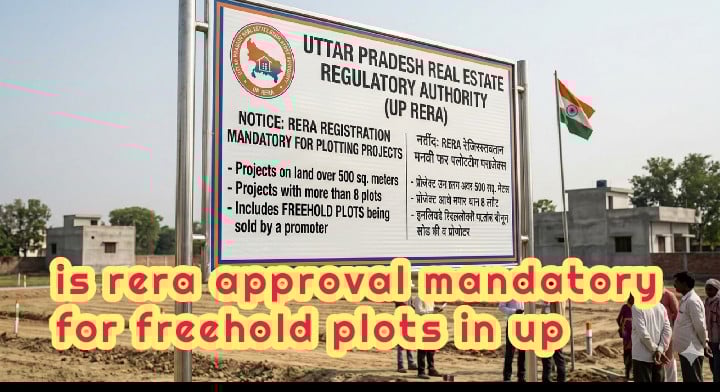
Without taking up any more time, let's proceed to the legal core of the matter. According to Section 3 of the RERA Act, any real estate project must be registered with the authority if it meets either of the following criteria:
The total area of the land proposed to be developed exceeds 500 square meters.
The number of apartments (or in our case, plots) proposed to be developed exceeds eight.
This applies to all phases of a project. So, if a developer buys a large patch of freehold land in the outskirts of Ghaziabad, carves it into 20 small plots, and starts selling them to the public, that developer must register that project with UP RERA. It doesn’t matter that the land is freehold. The act of "developing" and "offering for sale" triggers the legal requirement.
In My Experience: The Private Developer Trap
In my experience, this is where many buyers get caught. Local developers often buy agricultural land, get it converted for residential use (the 143 conversion in UP), and then tell buyers, "It’s freehold land, brother, RERA isn't needed here."
Please, do not fall for this. If they are selling you a plot in a "colony" or a "township" that has internal roads, electricity poles, or any promised amenities, and that colony is larger than 500 square meters, it requires a RERA number. If they don't have one, they are technically selling an unauthorized project, and you, as a buyer, are taking on a massive risk.
When is RERA Approval Not Mandatory?
It would be unfair to say that every single plot sale in UP needs RERA. There are specific exemptions:
Small Projects: If the total land is less than 500 square meters and there are fewer than 8 plots, the developer is exempt.
Personal Use: If you own a piece of freehold land and decide to split it into two to give to your children, or sell one half to a neighbor without any marketing or "project" development, RERA is not required.
Secondary Market (Resale): If you are buying a plot from an individual who bought it years ago, this is a "buyer-to-seller" transaction. RERA regulates the relationship between a Promoter and an Allottee. It doesn't usually govern a simple resale between two private individuals, though the original project the plot belongs to should ideally have been registered if it was built after 2016.
Old Projects: Projects that received a Completion Certificate (CC) before May 1, 2017, are exempt from registration.
Why Does the "Freehold" Label Confuse People?
The confusion often stems from the fact that many freehold plots in UP are located in "unauthorized colonies." These are areas where land was sold without a sanctioned layout plan from the local development authority (like LDA in Lucknow or GDA in Ghaziabad).
In these cases, the developers bypass RERA because they haven't even gotten their maps approved by the local city planning office. They use the term "Freehold" as a marketing gimmick to make the buyer feel a sense of absolute ownership, hiding the fact that the project itself lacks legal standing. Buying such a plot might get you a "registry" (sale deed), but it won't get you a "mutation" or a "possession" that the law fully protects.
The 2026 Landscape: What’s New?
As we navigate 2026, UP RERA has tightened the screws significantly. Here is what you need to know about the current environment:
Mandatory Agent Certification: As of late 2025 and into 2026, every real estate agent in UP must undergo a mandatory training and certification program. If your broker isn't certified, they can't legally facilitate the sale of a RERA-registered project.
Digital Verification: The UP RERA portal has become incredibly robust. You can now see the "Quarterly Progress Reports" (QPR) of every registered plotted development. If a developer promised a park and a boundary wall by March 2026, you can check online if they’ve actually done it.
Stricter Penalties: The authority has started imposing heavy fines on developers who market "freehold colonies" without RERA numbers. They are even working with local electricity departments to ensure that unauthorized colonies don't get permanent connections easily.
The Risks of Buying a Non-RERA Freehold Plot
You might ask, "If the land is freehold and the registry is done, why do I care about RERA?" As far as reality is concerned, the registry is just a record of a transaction; it doesn't guarantee that the land can be used for what you intend.
No Legal Recourse: If the developer disappears without laying the roads or providing water lines, you cannot go to RERA for help. You’d have to fight a long, expensive battle in civil court.
Demolition Risk: If the local development authority finds the colony is unauthorized, they have the power to demolish any structures built there.
Loan Issues: Most reputable banks (SBI, HDFC, ICICI) will refuse to provide a home loan for construction on a plot that is part of an unregistered "colony," even if the land is freehold.
Conclusion: Safety Over Hype
My dear friends, the allure of "Cheap Freehold Plots" is often a siren song that leads to financial heartbreak. In the Uttar Pradesh of 2026, the law is clear: if a promoter is developing land for sale and it hits the size threshold, RERA is mandatory. Don't let a developer's charm or the "freehold" label blind you to the necessity of regulatory protection. A RERA-approved plot gives you a defined timeline for development, an escrow account for your money, and a powerful authority to stand behind you if things go wrong.
In my experience, the peace of mind that comes with a RERA-registered project is worth every extra penny you might pay. It turns a "piece of land" into a "secure asset."