
penalty for builders without rera registration in yamuna authority
Discover the severe penalties, including massive fines and potential imprisonment, that builders face without UP RERA registration in the Yamuna Expressway (YEIDA) area. Stay informed to avoid costly consequences.penalty for builders without rera registration in yamuna authority
NCR REGION UP
Rajesh Kumar
3/21/20267 min read
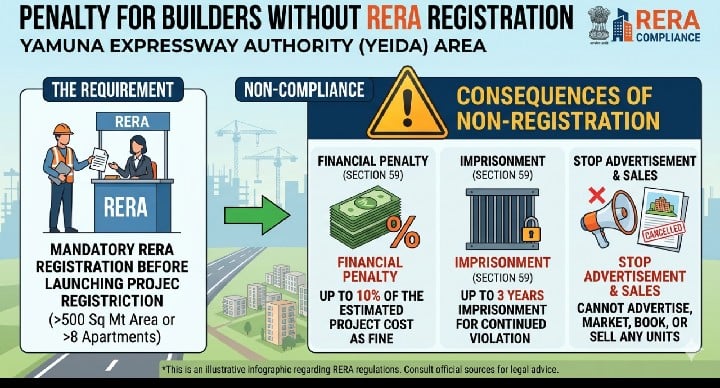
Yamuna Expressway Dreams: The Hard Reality for Builders Skipping RERA Registration
The allure of the Yamuna Expressway region is impossible to ignore. Every time I drive down that smooth stretch of tarmac, I see the massive hoardings, the sprawling construction sites, and the sheer scale of the vision. With the upcoming Jewar International Airport, the Film City, and the dedicated industrial clusters, this area is widely regarded as one of India's most significant real estate frontiers.
Thousands of homebuyers are flocking here, investing their life savings into a dream of owning a home or a high-yield commercial space near this hub of future economic activity. But where there is unprecedented opportunity, there is also, unfortunately, a breeding ground for exploitation.
My dear friends, while the growth story here is incredibly exciting, we need to talk about the shadow that often hangs over it: the unscrupulous practices of builders who attempt to operate outside the law. Specifically, those who launch projects within the Yamuna Expressway Industrial Development Authority (YEIDA) jurisdiction without mandatory RERA registration.
The Real Estate (Regulation and Development) Act, 2016 (RERA), was enacted with a very clear purpose: to bring transparency, accountability, and financial discipline to the real estate sector. It was designed to protect you, the homebuyer. Yet, even years after its implementation, some builders continue to prioritize their cash flow over their legal obligations, setting themselves—and, more tragically, their customers—up for significant trouble.
Let's explore this now. What exactly are the penalties that await builders who dare to bypass RERA registration in the Yamuna Authority area? The consequences are severe, multifaceted, and designed not just to punish, but to deter.
The Foundation of the Law: Why Registration is Mandatory
Before we examine the penalties, it is crucial to understand the obligation. According to Section 3 of the RERA Act, 2016, no promoter (builder or developer) can advertise, market, book, sell, or offer for sale any plot, apartment, or building in any real estate project without registering the project with the specific State RERA Authority.
In this context, we are talking about the Uttar Pradesh Real Estate Regulatory Authority (UP RERA), which oversees compliance in the YEIDA region. RERA applies to all commercial and residential projects where the land to be developed exceeds 500 square meters or the number of apartments proposed to be developed exceeds eight.
The act of registering is not a mere formality. It requires the builder to disclose detailed project information, including land title status, approvals, architectural plans, development timeline, and most importantly, financial disclosures. The law forces the builder to maintain accountability.
The Financial Squeeze: Up to 10% of Project Cost
The most immediate and perhaps most painful penalty for a builder operating without RERA registration is the massive financial liability detailed in Section 59 of the Act.
Without taking up any more time, let's proceed directly to the specifics of the RERA penalty clauses. Section 59(1) of the RERA Act states:
"If any promoter contravenes the provisions of Section 3 (mandatory registration), he shall be liable to a penalty which may extend up to ten per cent of the estimated cost of the real estate project, as determined by the Authority."
This is not a slap on the wrist. Think about the scale of projects in the Yamuna Expressway region. We are dealing with vast residential townships and commercial hubs. The estimated project cost often runs into hundreds, sometimes thousands, of crores.
A 10% penalty on a ₹1,000 crore project is ₹100 crore. This is a potentially project-killing fine. It is designed to be substantial enough that the risk of operating illegally far outweighs any perceived benefit of dodging compliance.
This penalty applies the moment a builder begins marketing or accepting bookings without the required registration. The Authority (UP RERA) has the power to estimate the project cost based on available data and impose this hefty fine.
The Ultimate Consequence: Imprisonment for Continued Violation
For those builders who think they can simply pay a fine as a cost of doing business and continue their non-compliant ways, the law has a much sharper bite. RERA doesn’t just stop at financial penalties; it provides for criminal consequences.
Section 59(2) of the Act outlines the penalty for continued violation:
"If any promoter continues to violate the provisions of section 3, after being punished under sub-section (1), he shall be punishable with imprisonment for a term which may extend up to three years or with a fine which may extend up to a further ten per cent of the estimated cost of the real estate project, or with both."
In my experience, the threat of imprisonment is where reality truly sinks in for many promoters. While large financial penalties might be cushioned by investors or complex financial engineering, the possibility of a three-year prison term for the company’s directors and management is the definitive deterrent.
This section ensures that non-compliance is treated as a severe offense. It signifies that the state will not tolerate persistent disregard for the rule of law and the rights of consumers. The law moves from being a regulatory hurdle to a criminal statute for repeat offenders.
Beyond the Act: The Yamuna Authority (YEIDA) Action
While UP RERA is the primary regulatory body enforcing the RERA Act, the Yamuna Expressway Industrial Development Authority (YEIDA) itself plays a pivotal role. The Authority, as the lessor of the land, has significant powers to ensure all development under its purview is lawful.
As far as reality is concerned, builders operating without RERA are almost certainly violating the terms and conditions set by YEIDA as well. The relationship between UP RERA and YEIDA is crucial here.
YEIDA frequently issues directives that link project approvals and clearances to RERA compliance. For a builder to successfully complete and deliver a project in the Yamuna area, they must adhere to a strict progression of approvals. These approvals are contingent upon valid legal standing.
When UP RERA penalizes a builder for non-registration, YEIDA is likely to take concurrent actions. These can include:
Halting Construction: YEIDA can issue immediate 'stop-work' notices on the project site. If a project is illegal under RERA, the Authority will not permit the physical work to continue.
Cancelling Approvals: The Authority can revoke building map approvals, environmental clearances, or other critical permissions that are necessary for the project’s legal existence.
Cancellation of Lease Deed: This is the nuclear option. If a builder persistently violates regulations and terms of allotment, YEIDA has the power to cancel the land lease deed altogether. This means the builder loses all rights to the land, and the project collapses entirely.
For the builder, losing the legal right to the land in the Yamuna Expressway region means the complete forfeiture of their investment and business operations in that key market. The penalty, in essence, is the death of the project and the company's reputation in the region.
The Practical Impact: The End of Project Viability
The penalties we’ve discussed—the 10% fine, the imprisonment, and the authority actions—are legalistic. But the practical, on-the-ground impact for a non-compliant builder is just as devastating.
A project without RERA registration in the Yamuna Authority area is fundamentally unviable.
First, marketing becomes impossible. Most reputable advertising platforms and media agencies now mandate the RERA registration number before accepting real estate ads. A builder cannot generate buzz or reach a wide audience.
Second, the sales channels are cut off. RERA regulations also require real estate agents (brokers) to register. These agents are forbidden from promoting unregistered projects. If they do, they face their own severe penalties (a fine up to ₹10,000 per day during the period of violation, which can add up to 5% of the cost of the property). No legitimate broker will risk their livelihood for a builder who isn't compliant.
Third, financial institutions will refuse funding. Banks and non-banking financial companies (NBFCs) require RERA compliance as a non-negotiable prerequisite for providing construction finance to the builder or home loans to the buyers. Without a RERA number, the project is considered a toxic asset, starving the builder of the capital needed to complete construction.
The Human Side: Why This Penalties Exist
The severe penalties for builders who bypass RERA are not arbitrary. They are a direct response to the devastating losses faced by thousands of homebuyers in the pre-RERA era.
When a builder operates without RERA, they often engage in questionable practices, such as "pre-launches" or "soft-launches" that lure in buyers with attractive rates before approvals are secured. This is a gamble using the homebuyer’s money. If approvals are denied, or the builder siphons off the funds (a common issue RERA’s 70% escrow requirement aims to fix), the buyer has virtually no legal recourse beyond long, expensive, and often futile court battles.
RERA, through its stringent registration process and severe penalties, forces transparency. It compels the builder to have all necessary approvals in place before asking for money. It mandates a timeline. It creates a mechanism where the builder’s personal assets and freedom are at stake if they defraud customers. The penalties exist to provide the homebuyer with the security that was absent for so long.
A Final Word: Due Diligence is Non-Negotiable
The potential penalties for builders without RERA registration in the Yamuna Authority area—massive fines, jail time, and the cancellation of project approvals—are among the strictest regulatory measures in the Indian real estate market. They reflect a determined effort by both UP RERA and YEIDA to clean up the sector and protect the interests of genuine homebuyers.
But these penalties are reactive. They require enforcement. And they will not immediately recover the money already lost by unwary investors.
This is why your role is so vital. We must be responsible investors. The excitement of Jewar Airport or Film City should not blind us to the foundational rules of real estate investment.
Before you even fill out a booking form, demand to see the valid UP RERA registration number. Then, cross-check it immediately on the official UP RERA website (up-rera.in). Verify that all the details on the website—the project timeline, the architectural plans, the land status, and the list of required approvals—match what the builder is telling you.
Never, under any circumstances, invest in a "pre-launch" or "soft-launch" project that lacks a RERA number, regardless of how lucrative the discount may seem.
The Yamuna Expressway region holds immense promise. Let us, as an informed and careful community, ensure that our participation in this growth story is built on a foundation of legal security and mutual accountability. Do your homework. Stay safe. And never forget that compliance is the minimum standard, not a luxury.