
legal difference between abadi land and agricultural land in up
Navigating the complexities of buying land in Uttar Pradesh can be challenging. Understand the crucial differences between abadi land for living and agricultural land for farming to avoid legal issues.legal difference between abadi land and agricultural land in up
NCR REGION UP
Rajesh Kumar
5/2/20266 min read

My dear friends, if you’ve ever spent a summer driving through the heart of Uttar Pradesh, you know the vibe. You see endless stretches of bright green sugarcane, followed by a sudden cluster of brick houses with kids playing in the dirt yards, and then right back to the fields.
In my experience, most people look at that and just see "the countryside." But if you’re looking to buy a plot or build a home there, those two types of land—the fields and the clusters of houses—are worlds apart in the eyes of the law.
I’ve observed so many people get into hot water because they bought a beautiful piece of "cheap" land, thinking they could just start laying bricks, only to find out the government still considers it a farm. Let's explore this now, because understanding the legal difference between Abadi land and Agricultural land in UP will save you a massive headache (and a lot of money).
What Exactly is Abadi Land?
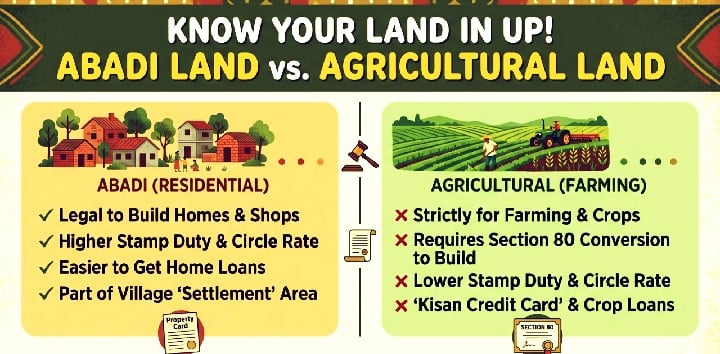
When we talk about Abadi land, we’re talking about the soul of the village. As far as reality is concerned, this is the area where people actually live. It’s the residential hub. In legal terms, specifically under the UP Revenue Code, Abadi refers to land that is used for housing, small shops, or communal village spots like the local well or a primary school.
The best way to think about it is "settlement land." If a piece of dirt is marked as Abadi in the village records (the Khatauni), it means the government acknowledges that this spot isn't for growing wheat—it’s for humans to stay.
One of my buddies once tried to buy a small plot on the edge of a village near Lucknow. He was so excited because it already had a small boundary wall. "It's Abadi," the seller promised. But when we checked the papers, it was still listed as agricultural. That’s a trap! Just because a house is standing on it doesn't mean the law calls it Abadi.
The World of Agricultural Land
On the flip side, we have Agricultural land. This is the backbone of UP. This land is strictly meant for farming, horticulture, or raising livestock. If you look at the official maps, this land is usually much larger and sits outside the dense residential clusters.
Here is the kicker: in UP, you cannot just wake up one day and decide to build a villa or a warehouse on agricultural land. I feel that many people underestimate how strict the state is about this. If the land is meant for crops, the law wants it to stay that way to protect the food supply and manage tax revenue.
Ownership Rights and the Revenue Code
Without further ado, let's proceed into the nitty-gritty of how the law treats these two differently. In Uttar Pradesh, the UP Revenue Code, 2006 is the rulebook everyone has to follow.
For Agricultural land, the person holding the land is usually called a Bhumidhar. You have the right to farm it, but your ownership is tied to the land's purpose. If you want to sell it to someone else for farming, it’s a pretty straightforward process.
However, Abadi land is a bit more relaxed once it’s officially designated. Since it’s already meant for living, you don't have to jump through as many hoops to build a roof over your head. I have observed that banks are also much happier to give you a home loan if the land is already classified as Abadi. Good luck getting a standard home loan for a plot that the government thinks is a potato patch!
The Section 80 Conversion Process
This is the part where things get real. Let’s say you find a stunning piece of land. It’s quiet, the air is fresh, and it’s currently a mustard field. You want to build your dream home there. Since it’s currently Agricultural land, you have to go through a process called Section 80 conversion.
In the old days, we called it Section 143, but under the new UP Revenue Code, it’s Section 80. Essentially, you are asking the Sub-Divisional Magistrate (SDM) to change the "character" of the land from farming to non-agricultural.
I’ve seen people skip this step because it costs money and takes time. They think, "Who will notice?" Well, the government notices. If you build on agricultural land without a Section 80 declaration:
* The government can tear your house down.
* You can’t legally register the building.
* You’ll face heavy fines.
It’s always better to play by the rules from day one.
Stamp Duty and Registration Costs
Let’s talk about the wallet for a second. Another huge difference between these two types of land is what you pay the government during the sale.
Usually, the Circle Rate (the minimum price the government sets for land in an area) is much lower for agricultural land than for Abadi land. Why? Because houses are worth more than dirt and seeds.
When you buy Abadi land, you are going to pay a higher stamp duty because the land is "developed" or "developable." If you try to buy Abadi land but register it as agricultural land to save on taxes, that is called under-valuation. It’s a crime, and the registry office has a habit of catching people doing this during audits. Trust me, the stress of a tax notice is not worth the few thousand rupees you might save.
Can Outsiders Buy This Land?
I get asked this all the time: "I'm not from a village, can I buy this land?"
If you are buying Abadi land that is already converted or sits within a controlled urban area, it’s usually like buying an apartment in a city. But buying Agricultural land in UP has more layers. While UP doesn't have the "farmer only" rule as strictly as some other states (like Himachal or Karnataka), there are still ceilings on how much land you can hold.
Also, if the land belongs to someone from a Scheduled Caste (SC) or Scheduled Tribe (ST), there are very strict laws (Section 98/99) that prevent them from selling to a non-SC/ST person without special permission from the District Collector. I have observed many buyers lose their entire investment because they didn't check the caste of the seller and whether the proper permissions were in place.
Inheritance Laws and Land Disputes
In my experience, disputes over Abadi land are often messier than agricultural ones. Why? Because Abadi land often doesn't have the same level of detailed mapping as farm fields.
For Agricultural land, you have the Sajra (map) and the Khasra (record of rights) which show exactly where the boundary sits. But inside the old village Abadi, boundaries are often "where the old neem tree used to be" or "where my grandfather built this wall."
If you are buying Abadi land, you must ensure the seller has a clear "Abadi Abhilekh" or is part of the Svamitva Scheme. This is a newer government program where they use drones to map village houses and give people "Property Cards." It’s a lifesaver for proving you actually own the house you live in.
Why Location Near Highways Matters
I want to share a quick story. A family friend bought a large plot near a developing highway in Noida. It was agricultural land. He waited two years for the Section 80 conversion. During that time, the area was declared an "Industrial Development Area."
Because he hadn't finished his conversion, the government compensated him at agricultural rates, which were much lower than commercial rates. If he had finished his paperwork sooner, he would have walked away with a fortune.
As far as reality is concerned, the legal status of your land determines its future value. Agricultural land is an investment in the earth; Abadi land is an investment in infrastructure.
Checklist Before You Sign Anything
If you’re feeling a bit overwhelmed, don’t worry. It’s a lot to take in. Here is a simple checklist I always tell my friends to use:
* Check the Khatauni: Look at the latest land records online (UP Bhulekh). Does it say "Krishi" (Agricultural) or "Abadi"?
* Ask for the Section 80 Certificate: If the seller says it’s residential but it looks like a field, ask for the conversion papers.
* Verify the Svamitva Card: If it’s in a village cluster, ask for their property card.
* Check for Encumbrances: Make sure the land isn't mortgaged to a bank for a crop loan (*Kisan Credit Card*). This is super common with agricultural land!
* Walk the Boundary: Physically check if the neighbors agree on where the land ends.
My Final Thoughts on the Matter
I feel that buying land in Uttar Pradesh is one of the best ways to build wealth, but you have to be smart. You can't just go by what a broker tells you over tea. You need to see the papers.
The legal difference between Abadi and Agricultural land isn't just a boring detail—it's the difference between owning a home and owning a legal nightmare. Abadi land gives you the right to live and build, while Agricultural land gives you the right to grow and harvest. Both are great, but they serve different purposes.
So, my dear friends, do your homework. Check those records, talk to a local lawyer if you have to, and always make sure the land's legal "label" matches what you plan to do with it.
If you keep these tips in mind, you’ll be well on your way to owning a piece of India’s most vibrant state without any of the drama. Happy land hunting!
What do you think is the biggest challenge when buying land in your area?