
Investing in Jewar Real Estate: RERA vs Non-RERA
Explore the essential differences between RERA-approved and non-RERA plots in Jewar real estate. Learn how to make informed decisions and secure your investment near the new airport.Investing in Jewar Real Estate: RERA vs Non-RERA
NCR REGION UP
Rajesh Kumar
3/14/20263 min read
My dear friends, if you have been tracking the real estate heartbeat of North India lately, your eyes are undoubtedly fixed on one map: Jewar. With the Noida International Airport transitioning from a distant dream to a runway-ready reality , the rush to own a piece of land in this corridor has reached a fever pitch. But as the saying goes, "All that glitters is not gold"—and in the world of real estate, all that is "land" is not necessarily a safe investment.
The most common dilemma I hear from investors and homebuyers alike is the choice between RERA-approved plots and non-RERA plots. It’s a classic battle between security and "perceived" savings. Let's explore this now and peel back the layers of what these terms actually mean for your hard-earned money.
What Exactly is RERA?
Before we dive into the comparison, we must understand the shield we are talking about. The Real Estate (Regulation and Development) Act, 2016 (RERA) was introduced to bring transparency and accountability to a sector that was once dubbed the "Wild West." In Uttar Pradesh, UPRERA acts as the watchdog.
As far as reality is concerned, a RERA-approved plot is one where the developer has registered the project with the authority, submitted all legal titles, obtained necessary NOCs (No Objection Certificates) from the local government (like YEIDA), and committed to a specific timeline for infrastructure development.
RERA Approved Plots: The Gold Standard
In my experience, the peace of mind that comes with a RERA registration number is worth every extra rupee you might pay upfront. Here is why RERA-approved plots are the preferred choice for serious investors in Jewar:
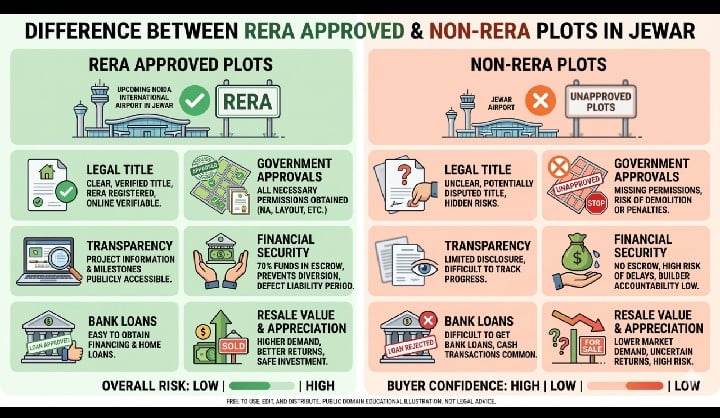
Legal Immunity and Clear Titles: When a project is RERA-approved, the authority has already scrutinized the land records. You don't have to worry about whether the land is still "agricultural" or if there’s a hidden dispute between three brothers from the 1990s.
Infrastructure Guarantees: On a RERA plot, the developer is legally bound to provide what they promised—be it 12-meter wide roads, sewage lines, or electricity connections. If they fail, you have a specialized court to go to.
Bank Finance Accessibility: If you are planning to take a loan, RERA is your best friend. Most reputable banks in 2026 will not even look at your file if the project lacks a RERA registration.
Resale Value: Looking ahead five years, a RERA-approved plot will always command a premium. Future buyers are becoming tech-savvy; they check the UPRERA portal before they check the site.
Non-RERA Plots: The High-Stakes Gamble
Now, why would anyone even look at a non-RERA plot? Usually, the hook is the price. Non-RERA plots in the deeper pockets of Jewar or near the villages are often significantly cheaper. However, without taking up any more time, let's proceed to the risks that often outweigh those savings.
The "Kachha" Registry Risk: Many non-RERA plots are sold through "Power of Attorney" or simple agreements that don't grant you full legal ownership (Mutation/Dakhil Kharij).
Encroachment and Demolition: The Yamuna Expressway Industrial Development Authority (YEIDA) is very strict. If you buy a plot in an unapproved colony, you risk the "bulldozer" action if the colony is flagged as illegal.
The Lack of Amenities: You might get a plot, but will you get a road? Or a transformer? In non-RERA developments, you are at the mercy of the local "colonizer" who may vanish once the last plot is sold.
The Jewar Context in 2026
The landscape around the Noida International Airport is changing daily. Government-planned sectors (like Sectors 18, 20, and the new 15C or 24A) are the safest bets because they are developed by YEIDA itself. However, many private developers are also launching gated townships.
If you are looking at a private developer, always ask for the UPRERA Registration Number. You can verify this in seconds on the official UPRERA website. If the developer says "RERA is applied for," treat it as "Not Approved" until that number is live.
Final Thoughts for the Smart Investor
Buying land is not just about the soil; it’s about the "Title" and the "Future." While a non-RERA plot might look like a bargain today, it can become a legal nightmare tomorrow. In my experience, the investors who made the most money in the Noida/Greater Noida growth story were those who stuck to legalized, approved layouts.
Jewar is the future of the NCR. Don't let the excitement of the airport make you overlook the paperwork. Secure your investment, verify the RERA status, and build your future on solid, legal ground.