
how to claim refund under rera for delayed projects in jewar
Are your savings trapped in a stalled real estate project in Jewar? Discover how to claim a full refund under the Real Estate Regulation Act (RERA) with our comprehensive guide. how to claim refund under rera for delayed projects in jewar
NCR REGION UP
Rajesh Kumar
3/25/20266 min read
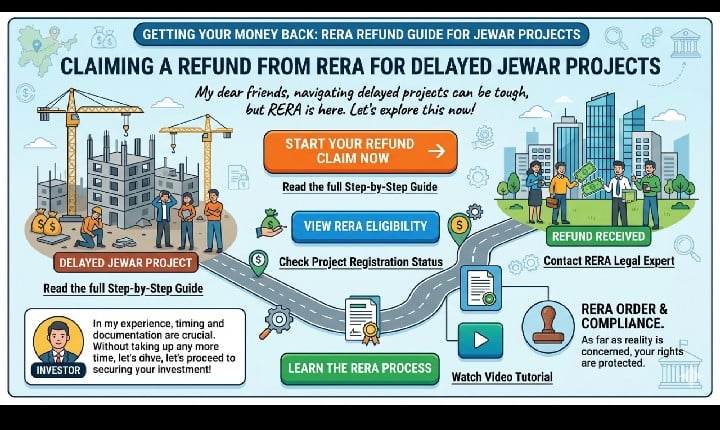
The Jewar Dream and the RERA Reality: Your Guide to Getting Your Money Back
My dear friends, we’ve all been there. You see the headlines about the Noida International Airport, the upcoming Film City, and the massive industrial hubs planned for the Yamuna Expressway. You imagine a life where your investment in Jewar isn’t just a piece of paper, but a thriving home or a high-value asset. But then, the months turn into years. The construction site remains a skeleton of concrete and rusted rebar, and the "possession date" in your agreement starts looking like a cruel joke.
If you’re reading this, you’re likely tired of the excuses. Maybe you’ve heard about "labor shortages," "supply chain issues," or "waiting for environmental clearances" for the tenth time. I know how heartbreaking it is to see your hard-earned savings stuck in a project that feels like it’s standing still. But here is the good news: you are not powerless. The Real Estate (Regulation and Development) Act—better known as RERA—was built exactly for people like us.
Let's explore this now, and dive deep into how you can claim a refund for a delayed project in Jewar.
The Reality of Investing in Jewar
As far as reality is concerned, Jewar is currently one of the most talked-about real estate hotspots in Asia. With the airport's first phase nearing completion in 2026, every developer wants a piece of the pie. However, the sheer scale of development has led to a "gold rush" where some builders launched projects without the financial muscle to finish them on time.
In the Yamuna Expressway area, projects are often massive, spanning dozens of acres. This leads to logistical nightmares and, unfortunately, a lack of accountability. But the law is clear: a delay is a breach of contract. Whether the developer is a small local player or a big name, they are bound by the dates they committed to in the UP RERA registry.
Understanding Your Superpower: Section 18
Before we get into the "how-to," you need to understand the "what." The most important weapon in your legal arsenal is Section 18 of the RERA Act. This section basically says that if a developer fails to give you possession of your apartment or plot by the date specified in the Agreement for Sale, you have two choices:
Withdraw and Refund: You can say, "I’m done. Give me back every penny I paid, plus interest."
Stay and Compensate: You can say, "I still want the house, but you have to pay me interest for every month of delay until you hand over the keys."
Most people stuck in Jewar projects for 5+ years are now looking for the first option. They want out.
Without taking up any more time, let's proceed to the actual steps you need to take to get that refund.
Step-by-Step Guide to Filing a Refund Claim in UP RERA
Filing a complaint isn't as scary as it sounds. You don’t even necessarily need a lawyer for the initial filing, though having one can help if the case gets complicated. Since Jewar falls under the jurisdiction of the Uttar Pradesh Real Estate Regulatory Authority (UP RERA), the process is largely digitized.
1. Registration on the UP RERA Portal
Everything starts at up-rera.in. You’ll need to create a profile as an 'Allottee.' You’ll need your PAN card, Aadhaar, and a valid email/mobile number.
2. Filling Form M
For a refund or interest on delay, you file Form M. This is the standard complaint form. You will be asked for:
The RERA Registration Number of the project (if the project isn't registered, that’s a different, bigger legal issue).
Details of the Promoter/Developer.
The total amount you have paid so far.
The specific relief you are seeking (e.g., "Full refund of ₹45 Lakhs with interest at MCLR + 1%").
3. Payment of Fees
As of 2026, the standard fee for filing a complaint in UP RERA is ₹1,000. This can be paid online via the portal. Keep the receipt!
4. The Hearing Process
Once filed, your case will be assigned to a bench. UP RERA has benches in Lucknow and Greater Noida. Since Jewar is in the Gautam Buddha Nagar district, your hearings will likely happen at the Greater Noida office (or via video conferencing, which is quite common now).
Documentation: Your Paper Trail is Your Best Friend
In my experience, the biggest reason cases get delayed in RERA isn't because the law is slow, but because the buyer didn't have their paperwork in order. If you want a refund, you need to prove three things: you paid the money, there was a promised date, and that date has passed.
Gather these documents immediately:
The Allotment Letter: This is the first official document you received.
Builder-Buyer Agreement (BBA): This is the most crucial document. It contains the "Possession Clause." Look for the specific date or the "number of months from excavation" clause.
Payment Receipts/Bank Statements: Every single Rupee you sent to the builder must be accounted for. If you took a home loan, get a statement from the bank showing the disbursements.
Correspondence: Every email you sent asking for updates and every "sugar-coated" reply the builder sent back.
Project Photos: If you can safely visit the site in Jewar, take photos. If it’s still just a hole in the ground two years after it was supposed to be finished, that's powerful evidence.
How Much Money Will You Actually Get?
This is the question everyone asks. It’s not just about the principal amount. RERA ensures you aren't just getting your money back; you're getting "time value" for it.
Principal Refund: 100% of what you paid to the developer.
Interest: UP RERA follows a formula of SBI MCLR (Marginal Cost of Funds Based Lending Rate) + 1% or 2%. Typically, this hovers around 10% to 11% per annum.
The "Parity" Rule: A major win for buyers in recent years is that the interest rate the builder pays you must be the same as the penalty rate they would have charged you if you were late on your payments. No more one-sided contracts!
Litigation Costs: You can also ask for a small amount (usually ₹10,000 to ₹50,000) to cover your legal expenses and the "mental agony" you’ve endured.
Common Developer Traps to Watch Out For
As far as reality is concerned, developers won't give up your money easily. They have a few "tricks" they use to try and bypass RERA orders:
The "Soft Possession" Letter: They might send you a letter saying the project is "ready for fit-outs" and ask you to take possession. Do not fall for this. Unless they have a valid Occupancy Certificate (OC) from the Yamuna Expressway Industrial Development Authority (YEIDA), the possession is not legal. Accepting "fit-out" possession can weaken your claim for a refund.
Force Majeure: They will blame everything from COVID-19 to "unforeseen rain" to the "NGT ban on construction." While RERA does allow for some grace periods for genuine issues, "lack of funds" or "bad planning" are not valid Force Majeure events.
The "Full and Final Settlement" Waiver: If they offer you a partial refund or a different unit in another project, they might ask you to sign a document saying you won't pursue further legal action. Read every word before you sign. Better yet, don't sign anything without showing it to someone who understands the fine print.
What If the Builder Ignores the RERA Order?
This is a common fear. You win the case, you get the order, but the builder just sits on it. In my experience, this is where many people give up, but you shouldn't.
If the builder doesn't pay within the stipulated time (usually 45–60 days), you file an Execution Application on the same UP RERA portal. RERA has the power to:
Impose daily penalties on the developer.
Request the District Magistrate (DM) to recover the money as "arrears of land revenue." This means the DM can actually attach the builder's bank accounts or even auction their property to pay you back.
It takes time, yes, but the recovery process in Uttar Pradesh has become significantly more streamlined recently.
Why Jewar Buyers are in a Unique Position
Investing in Jewar is different from investing in Noida or Gurgaon. Most of the land here is governed by YEIDA. If your builder is consistently failing, you can also approach the YEIDA office. Sometimes, collective pressure from an Allottees' Association can force the authority to take over the project or cancel the builder's lease, which provides another layer of leverage.
Moreover, because the airport is a "prestige project" for the government, there is a lot of pressure to keep the area clean of "fly-by-night" operators. Use this to your advantage in your arguments.
Final Thoughts: Don't Wait for a Miracle
My dear friends, the most important piece of advice I can give you is this: Time is not on your side if you do nothing. Many people wait, hoping the builder will suddenly find the money to finish the project. But while you wait, the builder’s liabilities are growing, and their assets might be dwindling.
By filing a RERA complaint, you put yourself at the front of the line. You turn a vague promise into a legal decree. It might take a year of hearings and follow-ups, but the feeling of finally getting your hard-earned money back—with interest—is worth the effort.
Jewar is the future, but it shouldn't be built on your misery. You have the right to your money, and you have the law on your side. Take that first step today.