
How the proposed Jewar Bulandshahr rail link will impact land prices
Explore the Jewar-Bulandshahr rail link project connecting Noida International Airport with Bulandshahr. Discover its impact on real estate in North India, connectivity improvements.How the proposed Jewar Bulandshahr rail link will impact land prices.
ALL LANDS
Rajesh Kumar
3/6/20266 min read
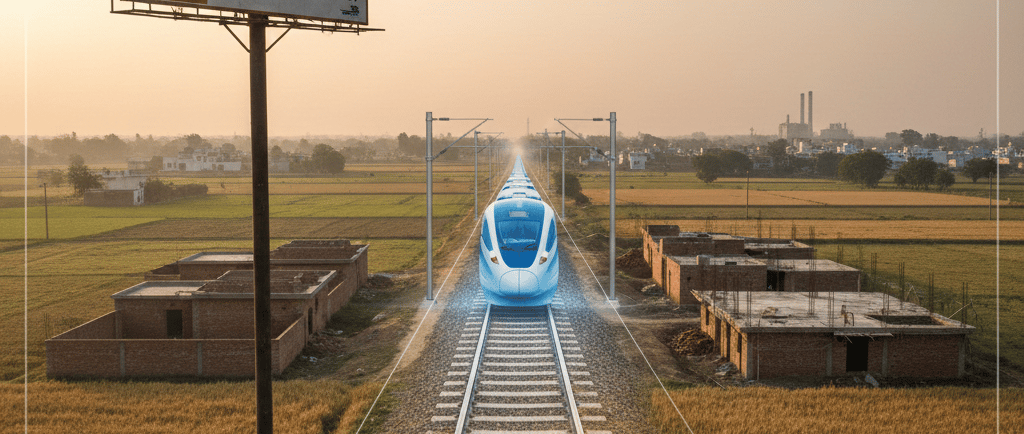
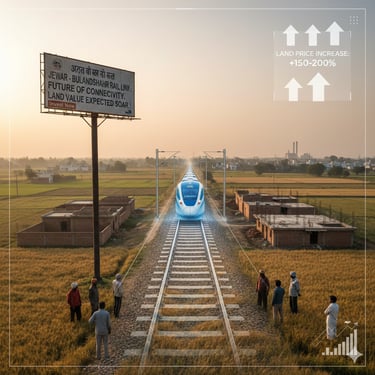
Jewar-Bulandshahr Rail Link: What is the Proposed Land Price and How Will It Transform the Region?
My dear friends, If you keep an eye on the real estate market in Delhi-NCR, Western Uttar Pradesh, or specifically the areas surrounding Jewar and Bulandshahr, you have undoubtedly heard about the Jewar-Bulandshahr (Chola) Rail Link. The construction of the Noida International Airport (Jewar Airport) is already revamping the entire region. But the biggest topic of discussion right now is—what land compensation (Land Price) is the government offering farmers for this rail link project?
In today's detailed blog post, we will take a deep dive into every aspect of the Jewar-Bulandshahr Rail Link project, the proposed land prices, the benefits to the farmers, and the massive economic impact this will have on the future of the entire region.
1. What Exactly is the Jewar-Bulandshahr (Chola) Rail Link?
To seamlessly connect Noida International Airport with the rest of the country, several mega connectivity projects are underway. As part of this, a blueprint has been prepared to lay a new railway line connecting Jewar Airport to the Delhi-Howrah main railway line. This new track will start from Jewar Airport and go up to the Chola Railway Station in Bulandshahr.
Once this rail link is completed:
Jewar Airport will be directly connected to the main network of Indian Railways (Delhi-Howrah route).
It will prove to be a game-changer not just for passengers, but especially for cargo and freight movement.
Bulandshahr and its surrounding areas will rapidly develop into a massive Logistics Hub.
The distance from Chola to Jewar will be covered in mere minutes, giving the industries of Western UP direct access to international markets.
2. The Biggest Question: What is the Proposed Land Price?
Whenever a massive infrastructure project is announced, the first impact is felt by the farmers and local landowners. Land acquisition is always a sensitive issue. For a long time, farmers have demanded fair, market-aligned compensation for their highly valuable land.
Recently, a high-level land acquisition committee and the Yamuna Expressway Industrial Development Authority (YEIDA) finalized the compensation rates for the land across 55 villages in Bulandshahr.
Keeping the convenience and future security of the farmers in mind, the government has introduced two distinct options:
Option A: All-Cash Compensation (Without a Plot)
If a farmer wants pure monetary compensation in exchange for their land and does not require a residential plot to settle there in the future, the government will pay them at the rate of ₹4,300 per square meter as a lump-sum amount.
Option B: Cash Compensation + 7% Developed Residential Plot
If a farmer prefers to receive a substantial cash amount along with developed land to live in the same area, the government will pay them at the rate of ₹3,800 per square meter. In addition to this cash, the farmer will be given a developed residential plot equivalent to 7% of their total acquired land area.
Let’s understand this with an example: Suppose the government acquires 10,000 square meters of land from a farmer.
If they choose Option A: They will receive a direct, one-time payment of ₹4.3 Crores (10,000 x 4,300).
If they choose Option B: They will receive ₹3.8 Crores in cash (10,000 x 3,800), plus a premium residential plot of 700 square meters (7% of 10,000) in a newly developed YEIDA sector.
3. How and Why Was This Rate Decided? (A Win for Farmers)
Initially, the authority was offering a compensation of ₹3,100 per square meter for the land surrounding Jewar Airport. However, as the project progressed toward the third and fourth phases of the airport, farmers protested that this rate was too low given inflation and the skyrocketing commercial value of the land.
The farmers of Bulandshahr (Chola region) argued that since their area is now part of the international airport's development zone and falls under YEIDA, they shouldn't be treated differently.
Listening to these justified demands, the UP Government made a historic decision to increase the compensation rate by nearly 40%. The rate of ₹3,100 was bumped up to ₹4,300 per square meter. Now, this increased rate is being applied to the Jewar-Bulandshahr rail link and the 55 villages of Bulandshahr selected for development.
4. How Will the Fate of 55 Bulandshahr Villages Change?
For this project, about 55 villages in the Bulandshahr district have been brought under the jurisdiction of YEIDA. Previously, these were standard agriculture-dominant villages, but today they are officially part of the master plan for 'New Noida' or the Dadri-Noida-Ghaziabad Investment Region (DNGIR).
Following land acquisition, the proposed developments in these villages include:
Jewar-Chola Railway Link: A dedicated track for passengers and heavy cargo.
Two New Expressways: Road networks to make connectivity between Chola Railway Station and Jewar Airport superfast.
Logistics and Warehousing Hubs: Massive warehouses and factories for e-commerce giants and heavy industries.
As money at the rate of ₹4,300 per square meter is distributed across these 55 villages, there will be a massive influx of cash flow into the local economy. History shows that when farmers receive heavy land compensation, that money circulates right back into the regional economy—whether through buying new properties, purchasing vehicles, or starting new businesses. The farmers of these 55 villages are on the verge of becoming millionaires overnight.
5. What Does This Mean for Real Estate Investors?
The announcement of the Jewar-Bulandshahr Rail Link is nothing short of a jackpot for real estate investors. For those who missed the bus on buying land right next to Jewar Airport (where prices have already skyrocketed), the Chola-Bulandshahr stretch is proving to be a goldmine.
Investors should keep these points in mind:
Avoid the Acquisition Zone: If you are buying land for investment purposes, ensure that it doesn't fall directly on the proposed railway line or the government's acquisition zone. If the government acquires your newly bought land, you will only get the official compensation (₹4,300/sqm). However, if your land is located just outside this zone, its commercial value could multiply several times over the next 5-10 years.
Have a Long-Term Vision: The stretch between Jewar and Chola will be more industrial/logistics-oriented rather than purely residential. Therefore, acquiring land for warehousing or commercial purposes will be highly profitable.
Conduct Strict Due Diligence: Before making any purchase, thoroughly study the 143 (land use change) regulations, land records (Khasra-Khatauni), and the YEIDA Master Plan 2041.
6. Impact on Locals and Employment
There was a time when the youth of Bulandshahr and Jewar had to migrate to Delhi, Gurugram, or Noida in search of employment. But with the operationalization of the Jewar-Bulandshahr rail link and the airport, the picture will completely flip.
Direct Employment: Thousands of people will be needed for the construction of railway stations, tracks, airport expansion, and managing warehouses.
Indirect Employment: Whenever an industrial hub is born, it is followed by a flood of schools, hospitals, hotels, restaurants, transport services, and retail shops.
Business Boom: The areas surrounding the Chola railway station will generate unprecedented opportunities for small business owners and vendors.
7. Which Option Should Farmers Choose? (An Expert Opinion)
Often, seeing a massive lump-sum amount, farmers quickly opt for Option A (₹4,300 cash). However, real estate and financial experts strongly believe that Option B (₹3,800 + 7% developed plot) is far more secure and profitable for the future.
Here are three major reasons why:
Land Appreciation: The 7% developed plot you receive today will shoot up in value like a rocket once the airport and rail link are fully operational. In a developed authority sector, this plot could be worth crores after a decade.
A Guaranteed Roof: After losing your agricultural land, your family gets a secure place to live, equipped with modern amenities like electricity, water, proper roads, and a sewage system.
Rental Income: In the future, you can build a house on that plot and rent it out to industrial workers or corporate executives, creating a permanent, lifelong source of income.
8. The Future Roadmap: 'New Noida'
The Jewar-Bulandshahr rail link is not just a railway track; it is the main artery of the upcoming 'New Noida'. In August 2023, the Noida Authority approved the Master Plan 2041 for New Noida (DNGIR), earmarking approximately 21,000 hectares of land.
This entire region is being designed to sync perfectly with the Delhi-Mumbai Freight Corridor and the Dadri Container Depot. When cargo arrives at Chola via train, it will travel straight to the Jewar Airport cargo terminal through this new rail link, and from there, it can be flown to any corner of the globe. This region is gearing up to become a massive part of the global supply chain.
Conclusion
The Jewar-Bulandshahr (Chola) Rail Link is a major milestone in Uttar Pradesh's development journey. The government's decision to set the land price at ₹4,300 per square meter shows that the administration wants to accelerate development by taking farmers along and giving them their rightful dues.
For farmers, this is a generational shift. They have the opportunity to become financially robust in exchange for their ancestral land and be part of a future world-class city. Meanwhile, for investors, this area is the biggest 'hotspot' of the coming decade. As the acquisition process speeds up and ground-level work begins over the next few months, both the landscape and the fortunes of this region will change forever.