
documents required for yeida plot registry in jewar
Are you ready to secure your land near the new Jewar Airport? Discover essential tips and a simple checklist for a successful YEIDA plot registry. Avoid common pitfalls and ensure your paperwork is perfect to make your dream a reality.documents required for yeida plot registry in jewar
NCR REGION UP
Rajesh Kumar
4/8/20267 min read
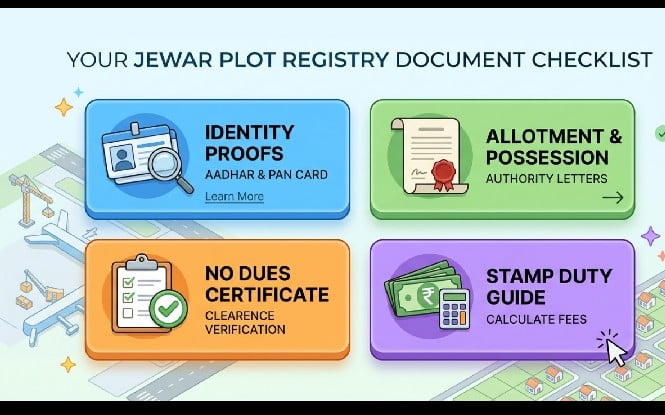
My dear friends, buying a piece of land near the new Jewar airport feels a bit like finding a golden ticket, doesn't it? I have spent a lot of time talking to folks who are looking at the Yamuna Expressway area, and the excitement is real. Everyone wants a slice of the action before that first plane takes off. But, as far as reality is concerned, the excitement can quickly turn into a headache if you don't have your paperwork in order. I’ve seen people get all the way to the finish line only to realize they forgot one tiny, stamped piece of paper. It’s frustrating, and I don't want that for you.
Without further ado, let’s proceed into the nitty-gritty of what you actually need to get your plot registered with the Yamuna Expressway Industrial Development Authority (YEIDA).
Getting Your Identity Proofs in Order for YEIDA
First things first, let’s talk about who you are. The government needs to know exactly who is buying this land. In my experience, this is where things should be simple, but people still find ways to make mistakes. You need your Aadhar Card and your PAN Card. These are the big two.
I remember a buddy of mine, Dave, who went to his registry appointment and realized his Aadhar card had his old address from three moves ago, while his PAN card had his current one. The clerk looked at him like he was trying to pull a fast one. It caused a week-long delay. I feel that you should double-check that the names and details on your ID cards match exactly. If your name is "Robert" on one and "Bob" on the other, fix it now.
You will also need several passport-sized photographs. Don’t just bring two; bring ten. I have observed that photos have a way of disappearing into files or getting smudged. Having extras makes you look prepared and keeps the process moving.
The Allotment Letter: The Birth Certificate of Your Plot
Now, let's explore this now—the Allotment Letter. This document is basically the birth certificate of your investment. YEIDA issues this when they first tell you that, yes, you have been granted a plot. It lists the plot number, the size, and the price you agreed to pay.
You cannot do anything without the original Allotment Letter. If you bought the plot directly from the authority in a lucky draw, you should have this in a safe place. If you are buying it from someone else (a resale), you need to make sure the seller hands over the original. I feel that holding this document in your hands for the first time is when it finally starts to feel real. It’s not just a dream anymore; it’s a specific piece of earth with a number on it.
Why the Possession Letter is Your Best Friend
Next on the list is the Possession Letter. This is the document that says, "Okay, the land is ready, and you can now physically take over." YEIDA issues this after they have finished the basic infrastructure like roads and electricity lines in that sector.
In my experience, some people try to rush the registry before the possession letter is even ready. While you can sometimes do the "Transfer Memorandum" (which we will talk about in a second), having that possession letter makes the registry much smoother. It proves the authority is happy with the state of the plot and that you are officially the one in charge of that dirt.
Managing the Transfer Memorandum for Resale Plots
If you aren't the original person who won the plot in the YEIDA lucky draw, things get a bit more interesting. You are buying a "resale" plot. In this case, you absolutely must have the Transfer Memorandum (TM).
Think of the TM as the authority's way of saying, "We acknowledge that Person A is selling to Person B, and we are okay with it." Without this paper, the registry office won't even talk to you. I have observed that getting the TM can take a few weeks because the authority has to check their records and make sure everything is legal. Don't skip this. If a seller tells you that you don't need it, they are wrong. As far as reality is concerned, the TM is your shield against any future legal drama.
The Power of the No Dues Certificate
This next one is a big deal. You need the No Dues Certificate (NDC). This is a letter from YEIDA stating that every single penny owed on that plot has been paid. This includes the original cost, any interest, and those pesky "extra compensation" fees that sometimes pop up for the farmers.
Let me tell you a quick story. A neighbor of mine bought a plot in Sector 18 and thought he was getting a steal. On registry day, he found out the previous owner hadn't paid the last two installments. He ended up having to pay out of his own pocket just to get the registry done because the seller had already disappeared with the bulk of the money. I feel that you should never, ever go to the registrar's office without a fresh NDC in your folder. It’s the only way to sleep soundly at night knowing no one is going to come knocking for more money later.
Calculating and Paying Your Stamp Duty
We have to talk about the money that goes to the government—the stamp duty. This isn't a "document" you just find; it’s a document you create by paying a fee. The amount depends on the size of your plot and the current circle rate in Jewar.
You usually pay this online through the SHCIL (Stock Holding Corporation of India Limited) website. Once you pay, you get a fancy certificate with a barcode. This is what the sub-registrar actually looks at to make sure the state got its cut.
I recommend using a professional calculator or asking a local expert for the exact amount. If you underpay by even a few dollars, the registrar will send you home. It’s better to pay a tiny bit more than to be a tiny bit short. In my experience, having the e-stamp certificate printed out and ready to go is the most satisfying part of the whole pile of paperwork.
Handling the Lease Deed and Site Plan
Since most land in the YEIDA area is on a 90-year lease rather than "freehold," you are going to be dealing with a Lease Deed. This is the big legal contract between you and the authority. You’ll need the draft of this deed ready for the registry.
Along with that, you need the Site Plan. This is a map that shows exactly where your plot sits. It shows which way it faces and who your neighbors are. It might seem like just a drawing, but it’s a legal requirement. I have observed that sometimes the site plan in the authority's records is slightly different from what people think they are buying. Check the dimensions! Make sure the "12-meter road" promised in the brochure actually exists on that map.
The Final Registry Day Checklist
When the big day finally arrives, you'll be headed to the sub-registrar's office (usually in Jewar or Greater Noida). My dear friends, this is where the rubber meets the road. Here is what you should have in your bag:
Original Allotment Letter and Possession Letter.
The Transfer Memorandum (if it’s a resale).
The No Dues Certificate (freshly issued).
The E-Stamp Paper/Receipt for the stamp duty.
The Registration Fee Receipt (usually paid online beforehand).
Your Aadhar and PAN cards (and clear photocopies).
Two witnesses with their own ID proofs.
Let's talk about the witnesses for a second. You need two people to come with you and sign the book saying they saw you sign the papers. Choose reliable friends. I once saw a guy waiting at the office for three hours because his witness decided to go grab a long lunch and didn't pick up his phone. I feel that you should pick someone who is punctual and doesn't mind a bit of waiting in a government building.
Dealing with the "Extra" Paperwork
Sometimes, life is complicated. If you are buying the plot in the name of a company, you’ll need the Board Resolution and the Memorandum of Association. If you are using a Power of Attorney (POA) because the buyer can't be there in person, that POA needs to be registered and verified.
In my experience, using a POA adds a whole new layer of scrutiny. The officers will look at it with a magnifying glass. If you can be there in person, please do. It makes everything ten times easier. As far as reality is concerned, being physically present shows the authorities that you are serious and minimizes the chance of any "clerical errors."
Why This Process Matters for Your Future
I know this sounds like a lot of paper. You might be thinking, "Can't I just pay the money and be done with it?" But think of it this way: Jewar is becoming a global hub. That plot of land might be worth five times what you paid for it in a few years. When you go to sell it later, the next buyer is going to be even more careful than you are.
I have observed that property with "clean" paperwork sells for a premium. If you have every single document we talked about today—the allotment letter, the NDC, the TM, the stamped deed—you are protecting your wealth. You are making sure that your kids or your future self won't have to fight a legal battle to prove ownership.
Let's explore this now—the feeling of walking out of that registrar's office. Your thumb is probably covered in ink, and you’ve spent half the day in a plastic chair, but you have that receipt in your hand. That piece of paper says you are an owner in one of the fastest-growing areas in the world. It’s a great feeling.
A Final Word of Advice
My dear friends, don't try to do this entirely alone if you're feeling overwhelmed. While you don't need a high-priced lawyer for everything, having a good document writer or a consultant who knows the Jewar sub-registrar's office can save you a lot of time. They know the "unspoken" rules—like which window to go to first or which photocopy needs to be self-attested.
In my experience, the staff at YEIDA are generally helpful, but they are very busy. If you show up with a messy folder and missing copies, they won't have the patience to help you sort it out. If you show up with a neat, organized file, you’ll be in and out much faster.
I feel that buying a YEIDA plot is one of the best moves you can make right now. Just stay patient, keep your documents organized, and don't let the bureaucracy get you down. Without further ado, go get that file folder started. Your future plot in Jewar is waiting for you!